Saturday, March 5, 2016

Buša Cattle, Cetina Culture and the Balkans

This is post that delves a little deeper in the development and geographic spread of the longifrons.    Reading the literature, you'll quickly find that it is necessary to constantly define terms within context of the person who wrote it.  Not everyone operates from the same sheet of music.

To simply things for the sake of conversation, longifrons belongs to the Taurus species.  It is either 1) the absolute oldest Taurus and all other Neolithic Taurine have Auroch admixture 2)  It is a more refined, younger Taurus 3)  It is a refined Taurus with something Indicus like, but not Indicus; and humpless.  4) it is no longer believed to have been a separate domestication event.  With that...

Busha Cow (Gatačko?), Stara Mountain, Serbia (photo by dobrogled)
Buša cattle (Illyrian Cattle) are an endangered domesticate of the Balkans whose ancestral racial type first appeared in this region at the beginning of the Early Bronze Age.  (Eric Issac, 1962) They actually form a dwarf Illyrian group with branches that can be found across the Balkans and Greece in low numbers.  (There is a paper that claims the presence of longifrons in Vinca Culture, the evidence of which is very thin IMO)

Busha belong to a race typified by Jerseys, Ayshire, Red Devons, Menorquinas, etc, although admixture with larger cattle has greyed the distinctions.  Busha are rather small, even for longifrons, and most seem to have a white nose and belly.  Some Busha will exhibt a very rare tiger strip pattern while others may be solid grey or black.  The Dinaric cattle [cymbal shot] are vigorous and do well in rocky landscapes, but they also have been out-performed by improved cattle and caught in the middle of destructive people wars.

In the last few decades there were as few as 20 in Croatia that were unmixed and maybe a total of a 100 in the entire region that were considered standard types.  Already under extreme pressure, one of the last unmixed herds was completely destroyed in Sarajevo during the war leaving an extremely tiny population to preserve.  There is now a fairly robust conservation effort in all of the Balkan countries to reclaim the Busha heritage (UN Croatia, Macedonia, SaveFoundation, Albania) (See also Prespa Cattle)

The very first documented longifrons in the British Isles is found in a Bell Beaker settlement (Trow-Smith, 2005) (Dale Serjeantson, 2011) and this, for all intents and purposes IMO, is almost always the case throughout Europe and its archipelagos [post on Balearic Islands] While it may not be the only cow utilized by the Beaker Culture, a very fair case can be made that it's expansion was driven by the Beaker culture (I'll develop this in a later post).  The earliest longifrons are considered to have a solid reddish brown coat (as observed in bogs for example), smaller body, short legs, a long forhead with a short and narrow face, short & forward facing-small-diameter polls that are partly cleaved, bug eyes, considerable sexual dimorphism, and to use the terminology of the Blues Brothers, their lips and asses are black.  

 Croatian Busa Cattle (via Fraxinus)
From the Illyrian group another dwarfed subset can be found in Greece, also endangered.  It appears longifrons followed settlers to the Peloponnese, Cyclades and Crete by way of communication or expansion of the Cetina sphere of influence (a baby Beaker) where it appears as a distinct cattle race, especially among the Achaeans.  Another longifrons appears out of thin air with the formation of the IE Hittites, but it is more likely the modern Turkish Black Anatolian came via Celtic migration in later history.  The Damascus group is a little more difficult to trace, but it could be residual of the Halaf or Hassuna Cultures, both at times implicated for its spread.

Domesticated animals are absolutely one of the strongest artifacts of prehistory.  It's important to remember the most valuable chattels of prehistory were not materials, they were beasts.  Until recently Europeans literally lived with the animals that defined their wealth, English "chattel", "capital", "fee", "fief".  The word 'fidelity' implies fealty to one's lord secured through fee (cattle).

People also do not necessarily migrate and adopt new animals in route, which is a common and utterly retarded belief (no pun intended).  For example, the Moors brought African cattle to an Iberia that already had cattle, while during the Reconquista, the Spaniards attempted to completely eradicate the infidel animals of the Moors and there is a large shift again (however complete) toward European breeds.  If people migrate, animals migrate.  I'll go to battle on this point.
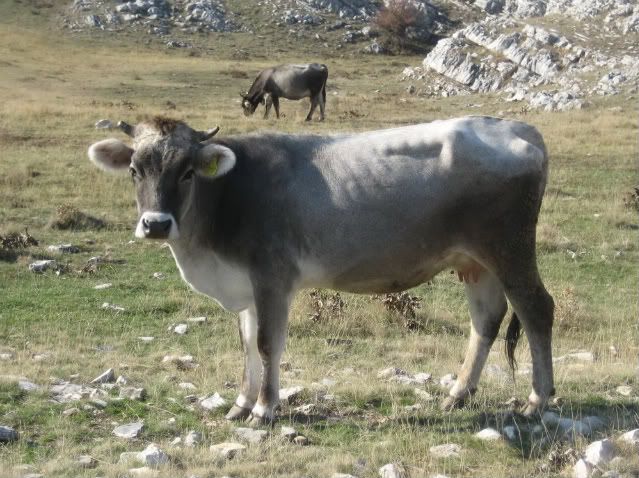
A Gatačko govedo, mixed Buša in the mountains (Planinac)
I would like to further delve into the armshutzeplaatzen-equipped Cetina Culture and some of the writings of Volker Heyd concerning the Beaker impact on the Northwestern Balkans in the mid-3rd millennium.  Aside from lithics, decoration, adventurism and people genetics, I think a strong co-pilot for this Cetina influence is in fact the Brachykeratiki.  It's also a very portable cow, maybe not backpack size, but a weened calf (230kg or 500lbs) can sit quietly in a boat full of people paddling between islands.  It may be why Greek longifrons are even smaller from its parent, sounds goofy, but Greece has always been a maritime culture.

Busa in Lika, Croatia.  Notice tiger strip in middle cow

As far as I'm concerned, the longifrons is very likely 'the Beaker cow' and that case might easily be made in a number of ways, something I plan on poking at in the future.  Basically, I think longifrons, to bolt on the Damascus group, is likely a dairy adapted for semi-arid regions and I think that is telling when we consider the spread of lactase persistence by a people already implicated.


See also:

Broxham, Kugler, Medugorac (2015) "A Case Study of Genetic Strains of Busa Cattle..."

A Brief History of the Shorthorn Cattle Migrations...

Grigg (1972) "The Agricultural Systems of the World: An Evolutionary Approach"

McInernet, Jeremy (2010)  "The Cattle of the Sun: Cows and Culture in the World of the Ancient Greeks"

Hristov et al (2015) "Mitochondrial diversity in autochthonous cattle breeds from the Balkan Peninsula"

SIMČIČ et al (2008) "Genetic Characterization of Auochthonous Cattle Breeds, Cika and Busha, Using Microsatellites"

Budimir et al (2014) "Mitochondrial DNA as a tool for identification of genetic diversity among domestic animals"

* Quick note.  Understandably, many resources online confusingly equate longifrons, which is Latin for "long faced" with longhorns, which it is not by definition.  Remember: longifrons have short horns!

** The earliest accepted absolute date of longifrons in is the LN Swiss Pile Dwellings and this is also true for pressure formed, bifacial retouched arrowheads.  Switzerland, OTOH, may have some weird dating problems (Alasdair Whittle, 1988) and, aside from being a bit of an outlier, the clines appear to come out of SW Iberia.


See also: "On the Breeds of Cattle—Historic and Current Classifications" Felis et al, 2011 [Link]

Thursday, March 3, 2016

Dunstable Echinoid Burial (Henry Rothwell)

Here's and article in Digital Digging [Link] by Henry Rothwell in which he examines a very old excavation of what is now identified as a young Beaker wife and several small children.  (Called Celtic in the original excavation)

There is an AMAZING wreath of echinoids that surround the occupants, something we've talked about [here] and [here] recently.


A diagram, I believe from the original excavator, via Digital Digging.

If you read the article, you'll notice that there is mention of cow 'horn cores', probably from the longifrons bones mentioned in the excavation.  These are likely baby bottles as are commonly found among the Asian steppe cultures.

*Update.  I'm curious about the placement of echinoids in burials.  At least in this one, they surround the occupants in a perfect ring.  In later times, the echinoids would be associated with the thunder and lightning war god.  I wonder if this is protection or a warning?. Either way, the grave appears to have been plundered in antiquity.

Monday, February 29, 2016

Cattle Size, Before and After the EBA

I found this paper from last year.  Very interesting data with many variables that might explain the phenomenon.

From the earliest Neolithic, continental cattle become progressively smaller.  The largest crash occurs about a thousand years after the beginning of the Neolithic.  Then sometime around the turn of the 3rd millennium, cattle shrink to their smallest size, or rather their size as observed at death.  Then at the beginning of the Early Bronze Age there is a marked increase in cattle size (and people size).

The authors rule out racial introgression with wild aurochs since that would obviously make the cattle bigger, not smaller.  They don't seem to consider the reverse scenario, that is the earliest Neolithic cattle are artificially large and they also don't consider introgression from newly introduced domestic races, such as steppe cattle or longifrons, both of which could impact this chart.


The authors consider two probable hypotheses, one being dairy intensification (very plausible), the other is breeding springers and slaughtering cows thereby decreasing calf size due to calving issues. 

I'm not sure I understand this second hypothesis because suggests a herd mix that is opposite of hypothesis 1.  Also, the decrease in cow size would seem to more often cause calving problems, but whatever.

There's about fifty different potential causes for the decrease in cattle size from the beginning of the Neolithic, all a totally valid and together may help explain much of this.  OTOH, it's hard to look at chart that parallels that of human size during a period of epic mobility.


Size Reduction in Early European Domestic Cattle Relates to Intensification of Neolithic Herding Strategies

Katie Manning, Adrian Timpson, Stephen Shennan , Enrico Crema  [Link]
PLOS

Published: December 2, 2015
DOI: 10.1371/journal.pone.0141873


Abstract:

Our analysis of over 28,000 osteometric measurements from fossil remains dating between c. 5600 and 1500 BCE reveals a substantial reduction in body mass of 33% in Neolithic central European domestic cattle. We investigate various plausible explanations for this phenotypic adaptation, dismissing climatic change as a causal factor, and further rejecting the hypothesis that it was caused by an increase in the proportion of smaller adult females in the population. Instead we find some support for the hypothesis that the size decrease was driven by a demographic shift towards smaller newborns from sub-adult breeding as a result of intensifying meat production strategies during the Neolithic.

Wednesday, February 24, 2016

Economic Foundations of Social Supremacy to Beaker Groups (Guerra Doce and Von Lettow-Vorbeck, 2016)

"Analysis of the Economic Foundations Supporting the Social Supremacy of the Beaker Groups"


You can access the compendium which is open access from Archeopress [here]


These papers look at the monopolization of intercontinental and intracontinental trade that distinguish the Beaker Compelx in prehistory.  Beaker Incorporated, L.L.C. appears to have executed a "hostile takeover" of many local industries and trade routes throughout Europe.  I think you see this everywhere, from Poland to Perdigoes. 

Think of the 'Beaker package'.  All of its constituents (v-perforated buttons, amber whoring, daggers, etc) belonged to different and preceding cultures from around Europe, but the Bell Beaker integrated the materials because it controlled of all of it.  This is partly why I'm weary of a 'Beaker package' because distracts from the ideological and ethnic core of people, who liked stuff.

In the contribution over the salt trade by Doce, she makes reference to the argument of Van der Noort that the settlement patterns of Beakers are largely determined by nautical avenues, something that should be increasingly obvious.  Lermercier has described a similar pattern in Mediterranean France to which he calls the 'Greek Implantation Model' via maritime avenues.

I may continue with another post on stateless economies in the near future.  Aside from genetics and worldview, I think the economic question is in the top three concerns of the Beaker phenomenon to explore.

Here's a rundown the papers:

Foreword to the XVII UISPP Congress Proceedings Series Edition 
Luiz Oosterbeek

Introduction
Elisa Guerra Doce and Corina Liesau von Lettow-Vorbeck

Graves of metallurgists in the Moravian Beaker Cultures
Jaroslav Peška

Bell Beaker funerary copper objects from the center of the Iberian Peninsula in the context of the Atlantic connections
Concepción Blasco Bosqued, Ignacio Montero and Raúl Flores Fernández

Bell Beaker connections along the Atlantic façade: the gold ornaments from Tablada del Rudrón, Burgos, Spain  Andrew P. Fitzpatrick, Germán Delibes de Castro, Elisa Guerra Doce
and Javier Velasco Vázquez

Prestige indicators and Bell Beaker ware at Valencina de la Concepción (Sevilla, Spain)
Ana Pajuelo Pando and Pedro M. López Aldana

Some prestige goods as evidence of interregional interactions in the funerary practices of the Bell Beaker groups of Central Iberia
Corina Liesau von Lettow-Vorbeck

Salt and Beakers in the third millennium BC
Elisa Guerra Doce

The role of flint arrowheads in Bell Beaker groups of the Central Iberian Peninsula
Patricia Ríos Mendoza

El Peñón de la Zorra (Villena, Alicante, Spain): change and continuity in settlement pattern during Bell Beaker
Gabriel García Atiénzar

Elements for the definition of the Bell Beaker horizon in the lower Ebro Valley: preliminary approaches
Anna Gómez, Patricia Ríos Mendoza, Marc Piera and Miquel Molist

Monday, February 22, 2016

Orkney Woman in the Foreshore (Lorena Innes)

More Sea Urchins.  This is a news report from Past Horizons: "Cist in the Foreshore"

This is Early or Middle Bronze Age burial has a wide wiggle range, but it was probably an EBA burial.  The full archaeology report can be found here "ARO19: The Cist on the Foreshore at Lopness, Sanday, Orkney" by Lorna Innes  (search AR019)
Woman from Lopness on Sanday
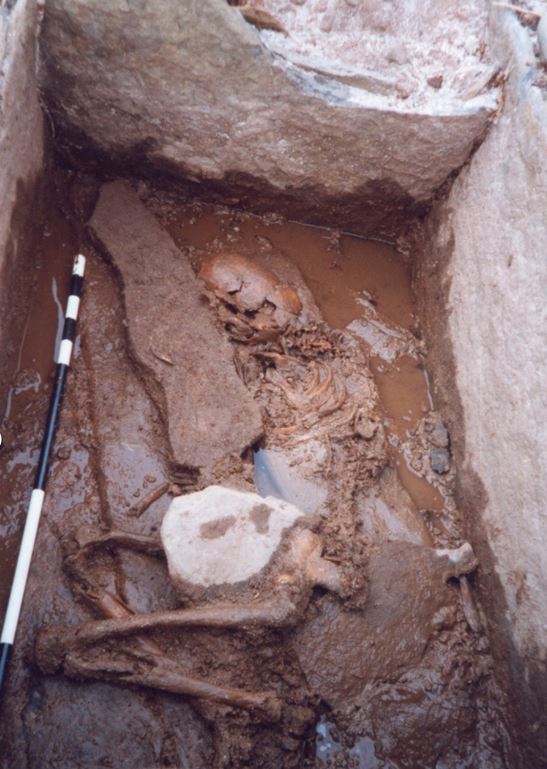
The westward facing woman was a middle aged and had worked hard her whole life with some osteoarthritis in later years.  Her bones indicate some repetitive activity, so it's thought maybe mending fishing nets or textile work. 

Although there is no diagnostic pottery, there is in addition to sea urchins, lobster, fish bones, and two baby lambs. The radiocarbon date, taking other variables into account, is 1890 - 1520 B.C.  The grave roof appears to have collapsed, possibly during the lifetimes of those who buried her, and it was again filled through the crack with more offerings (if I am reading this correctly).

It sounds as if the burial was covered with a large mound of dirt from the inland.   Apparently this had nondescript pottery fragments and knapping debitage.  


You have to wonder if there was a special desire by the deceased to be buried by the sea just as someone might request today..?

What's remarkable about modern Orkney is that R1b and R1a constitute about 93% of male lineages.  If you assume that the large portion of R1a comes from Northmen, the highest percentage in the Isles, then must certainly accept that the majority, if not the totality of the 8% haplogroup I did as well. 

After removing that, what are we left with?  What components of Orkney or Shetland could represent the male posterity of the Neolithic?  It's may sound ludicrous, but it's looking like 0%.

The only other scenario that's halfway plausible is that the Orkney grooved ware tradition was in fact Western Iberian in origin and the island was overwhelming R1b prior to the Beaker advance.  If this was the case, then the R1b-ization of the Isles could have begun several hundred years before the Beaker times with the Grooved Tradition.  I don't lean this direction, just saying it's remotely plausible.

See the paper, lot of interesting thingsMore on the Neolithic excavations, see:

Orkney Jar