Tuesday, September 17, 2019

Stunning Jet Necklace (Isle of Man)

This is a stunning 122 bead jet necklace from the Round Mounds on the Isle of Man.  Just uncovered by Drs. Chip Fowler and Rachel Crellin.  See the BBCs "Isle of Man Round Mounds: 'Spectacular' 4,000-year-old jet necklace found"

See also, the Round Mounds blog in the sidebar.
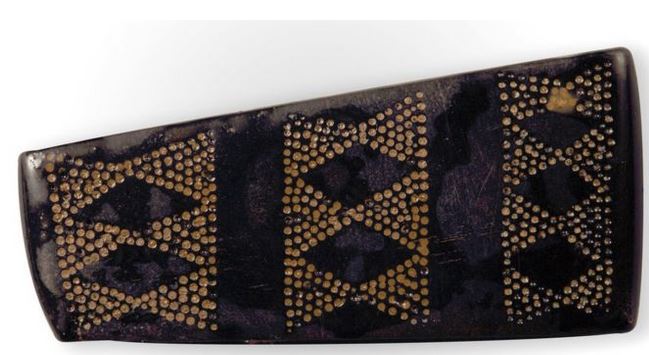
Jet plate Via BBC

It appears the archaeologists have already been able to reassemble the necklace and have said it is crescent shaped, though the final assembly has not been publicized.  Jet black seems to have been a luxury item worn by women during the Beaker period, mostly in Britain, and then mostly in Northeastern Britain.  The archaeologists seem to think this material made its way from Whitby, North Yorkshire.


This is an important find for understanding the Beaker period of the Isle of Man.  For one, it shows that the people living on Man were more connected to the outside world than previously thought.  Importantly for Man is the fact that they have skeletal remains of a (probable) Beaker for the first time (the other burials have all been cremations).  This individual (maybe a woman) may answer some questions about the settlement of the island and the integration of the previous natives if her ancestry is significantly mixed, or not.  There appears to be an isotope and DNA analysis underway and that will be huge.

jet plate via BBC

The Berk Farm necklace really changes how prehistoric Man may be viewed in the context of the neighboring islands.  These people were wealthy enough, or shallow enough, to desire fine things from distant places.  Or maybe they were just shallow people from distant places.  Isotopes may tell.

Fowler and Crellin via BBC

See the Newcastle University release

Monday, August 26, 2019

Drifting Around Denmark

Get ready for some SGC DNA.  Lots of questions and answers ahead regarding the relationship of SGC with the CWC and BBC nations.  These are the results of radiocarbon analysis on graves associated with the TRB, SGC, CWC and BBC's.  Will update later in the day, getting back in the saddle.


*afternoon update*

Here's one of the individuals that is likely to reveal the genetic affinities of the mysterious Single Gravers.  You may recognize a few of the authors of this paper, and I think a fair guess is that sometime within the next few weeks we'll have a genetic window to Denmark's past like Britain and Spain.  In those previous cases, the isotope/anthropology precedes the genetic paper by a few weeks or months.  They all have RISE numbers assigned, so they may be searchable if you know where to go.


Abstract

We present results of the largest multidisciplinary human mobility investigation to date of skeletal remains from present-day Denmark encompassing the 3rd and 2nd millennia BC. Through a multi-analytical approach based on 88 individuals from 37 different archaeological localities in which we combine strontium isotope and radiocarbon analyses together with anthropological investigations, we explore whether there are significant changes in human mobility patterns during this period. Overall, our data suggest that mobility of people seems to have been continuous throughout the 3rd and 2nd millennia BC. However, our data also indicate a clear shift in mobility patterns from around 1600 BC onwards, with a larger variation in the geographical origin of the migrants, and potentially including more distant regions. This shift occurred during a transition period at the beginning of the Nordic Bronze Age at a time when society flourished, expanded and experienced an unprecedented economic growth, suggesting that these aspects were closely related.

Mapping human mobility during the third and second millennia BC in present-day Denmark
Karin Margarita Frei, Sophie Bergerbrant, Karl-Göran Sjögren, Marie Louise Jørkov, Niels Lynnerup,
Lise Harvig, Morten E. Allentoft, …  [Link]


Update.  Nick, got your email.  Today as a bit busy so I’ll be checking it out in the morning


Monday, July 8, 2019

Even Little Blaina...

Via Wales Online

There's a quick interview with Niall Sharples of Cardiff University on the Beaker People of Blaenau Gwent.

Wales has so many sleepy towns.  It's the epitome of the countryside, and yet its settlement by the Bell Beakers testifies to the speed and omnipresence of their pioneering.


Floorpan via Wales Online
The huts across the valley were first discovered by Ian Fewings of the Aberystruth History and Archaeology society.  Above you can make out the circular impression left by a Beaker hut.

Keith Gibbs Via Wales Online
These features are still rather new, or newly discovered.  I haven't seen any papers on these particular huts, but please share in the comments if there is something out there.

Wednesday, July 3, 2019

High at Haille de Pout (La Depeche)

The French website "LaDepeche" has an article about a returning campaign to a high-altitude Cirque de Troumouse burial mound in Hautes-Pyrénées.  The site, Haille de Pout, contains Bell Beaker and Early Bronze Age materials.

The following snips are from the video interview with archaeologist Maxim Remicourt seen below (beard).


If you'd like to be part of this team, L'université Toulouse-Jean-Jaures is looking for experienced volunteers for a two-week excavation August 2019.  
Archaeologist Maxim Remicourt

Here's a pretty rugged clay spoon that came out of the site.  Is that a perforation on the end?
Creuset-cuillere? (Maison 2-US 144 n* 154, Saint-Sever & Remicourt, 2017
"Des occupations d’altitude du Bronze ancien à la Haille de Pout dans le cirque de Troumouse (Gèdre, Hautes-Pyrénées)" Saint-Sever and Remicourt 2017 [also]

See more at grottesarcheologies

Friday, June 7, 2019

Real? Legal?

I am not familiar with European laws on trading antiquities, but does anyone know if this item being sold is legit or legal?

Here's the entry:  Marktplaast


My personal advice is to never buy anything unless it can be authenticated and it is legal and ethical to do so.  Using this rule, most of the cultural heritage being plundered and lost on shady sites like eBay can be quickly excluded.  Most of it is bullshit made in Algerian slums by slummy people, but every now and then a priceless artifact shows up in a garage sale.

I'm highly skeptical of the authenticity of the "beaker" above.