
 |
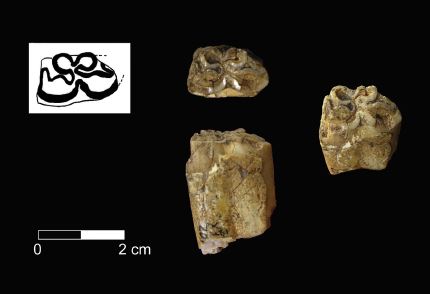
| Leceia Ass Tooth (Drawn by B. L. Ferreira; photos by J. L. Cardoso) |
The molecular evidence demonstrates an animal not native to Pleistocene Iberia as being present in Chalcolithic Leceia, it being a descendant of those wild asses native to Northeast Africa, possibly of a subgroup having been domesticated in Egypt or Mesopotamia. While it is impossible to ascertain whether this ass was domesticated, it would almost certainly need to be given the circumstances and the type of find.
The tooth of the ass at Leceia was directly dated to a range that is almost perfectly contemporary with the Standard of Ur, being the middle of the third millennium. This is fairly significant because, using the last post as one example, trade and cultural links between Iberia and the Eastern Mediterranean and North Africa are well demonstrated. Cardoso et al believe these trade links may have brought the donkey to Iberia at this time.
 |
| Sumerian chariots and donkeys trample a miserable soul c.2,500 (British Museum #1928,1010.3AN12575001) ( FI-000833573) |

And below is a general layout of the site from the paper. You can see the fortress is slightly north of the Tagus near modern Lisbon. It has been previously held that the Phoenicians brought the ass to Southern Europe (and the chicken as well), but at least for the ass, it has an older presence.

Leceia is one of the many great Portuguese walled enclosures that project on the surrounding landscape. The are built rapidly using the same plans at about the same time before falling into disrepair. Around the middle of the third millennium, Bell Beaker artifacts appear, as does changes in weaving and now dairy processing.
Cardoso has written about those artifacts and ceramics termed 'pre-campaniforme' [here] and those of the early campaniforme [here] and its general chronology to give a little context of this site.
One question that may be asked is, that if this is in fact a domesticated ass, why did it take so long to spread into Europe? I think this could partly be explained by the fact that the ass is a browser and better suited for hot climes and badlands, whereas the Asian horse, mostly a grazer, may have been more suitable for deforested, temperate Europe. If this sounds unreasonable, consider the fact that even after its most recent plausible introduction (with the Phoenicians), it still was not a widely used animal in Northern Europe, even with the Roman conquest and Christian missions.
As with the horse in the Late Neolithic, the evidence may have always been there and now new tools are revealing the provenance of materials and the sub-species of animal bones..
"First evidence of Equus asinus L. in the Chalcolithic disputes the Phoenicians as the first to introduce donkeys into the Iberian Peninsula" João L. Cardoso, Julia T. Vilstrup, Véra Eisenmann, Ludovic Orlando (2013) Journal of Archaeological Science 40 (2013) 4483e4490 [Link]


