Thursday, April 6, 2017

Fence Post Rings from EBA Switzerland

This awesome story "Prehistoric alphine farming in the Bernese Oberland" is from Phys.org.  It references a paper just released from Quarternary International.

The melting Alpine Ice fields are exposing lots of Neolithic stuff.  These fence rings are among the most recent finds.
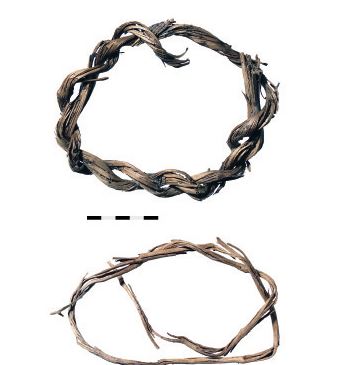
2,100 B.C. EBA Fence Post Rings (Photo: Badri Redha)
Not changing what works.  Fences were constructed like this up until a few generations ago in Switzerland.

The Swiss man is holding a fence ring, identical to the EBA rings above (Schweizerische Gesellschaft für Volkskunde)

Hafner, Schworer (2017) Quarternary Internationl http://dx.doi.org/10.1016/j.quaint.2016.12.049

"Vertical mobility around the high-alpine Schnidejoch Pass. Indications of Neolithic and Bronze Age pastoralism in the Swiss Alps from paleoecological and archaeological sources"

Abstract

Since 2003 a melting ice field on the Schnidejoch Pass (2756 m a.s.l.) has yielded several hundred objects from the Neolithic period, the Bronze and Iron Ages and from Roman and early medieval times. The oldest finds date from the beginning of the 5th millennium BC, whilst the most recent artefacts date from around AD 1000. Most of the objects belong to the Neolithic period and the Bronze Age and are of organic origin. A series of over 70 radiocarbon dates confirm that the Schnidejoch Pass, which linked the Bernese Oberland with the Rhône Valley, was frequented from no later than 4800–4500 BCE onwards. The pass was easily accessible when the glaciers descending from the nearby Wildhorn mountain range (summit at 3248 m a.s.l.) were in a retreating phase. On the other hand, the area was impassable during periods of glacial advances. A recent palaeoecological study of sediment cores from nearby Lake Iffigsee (2065 m a.s.l.) provides clear indications of early human impact in this Alpine area. Linking archaeological finds from the Schnidejoch Pass and the Rhône Valley with the palaeoecological data provides results that can be interpreted as early indications of Alpine pastoralism and transhumance. The combined archaeological and paleoecological research allows us to explain vertical mobility in the Swiss Alps.
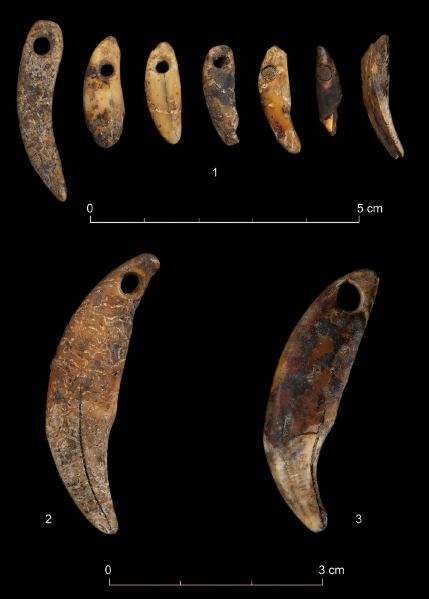
Woman with a Wolf-tooth Necklace (Włodarcczak et al, 2016)

This is a revisit of a Corded Ware Culture grave discovered in 1994,Wilczyce, Southwestern Poland.  The second half of the paper is in English.

Fig 11.  Some of the wolf-teeth pendants


The grave contained a large, tubby amphora, S-shaped beakers which include a complete and loosely patterned herringbone beaker, smaller but undecorated beaker fragments and two miniature vessels along with animal teeth pendants and shell beads.  The skull is apparently missing and the body was 'strongly disturbed'.

From Fig 9.  S-profile beaker, loose herringbone
Determining the gender of the occupant is impossible based on traditional methods.  An admittedly very shaky determination is female, and the authors note that wolf-tooth and bead necklaces are generally found with female-gendered burials. 

The flint fragments (17) may come from the filling of the grave, however this is also not determined.  There was a Carpathian grindstone made of sandstone.

41 wolf-tooth pendants were included of at least six adult wolves, drilled using different tools, perhaps at different times or by different people.  Along with the shell beads, the teeth and beads may have formed a single necklace and/or bracelets.

Fig 12.  Examples of shell beads
The grave dates to around 2500 or so and the authors remark it is rather conservative given its date, especially in this part of Poland.

Przegląd Archeologiczny, Vol. 64, 2016, pp. 29-57, PL ISSN 0079-7138, DOI 10.23858/PA64.2016.002.  Piotr Włodarczak , Tomas z Boro ń, Aldona Kurzawska ,
Marta Osypińska , Anita Szczepanek , Małgorzata Winiarska-Kabacińska  [Link]

The grave of the Corded Ware culture from the site 10 in Wilczyce, Sandomierz County

The authors of the paper present the results of research, the subject of which was the inhumation burial of the Corded Ware culture from Wilczyce. The site is located on the culmination of the southern slope of a loess hill, rising directly above the valley of the Opatówka River. The grave goods consisted of: an amphora, three cups, two miniature vessels, 41 wolf tooth pendants and disc-shaped shell beads. Radiocarbon dating result on bones from the burial is 3960 ± 30 BP (Poz-80189).
KEY WORDS: southern Poland, Wilczyce, the Neolithic, The Corded Ware culture, inhumation burial

Wednesday, April 5, 2017

Corded Ware Language, Culture (Kristiansen et al, 2017)

No lengthy overture.  The papers are here.  See also the summary on Kossinna's Smile.

Many of the bold assertions made in "Re-theorising mobility and the formation of culture and language among the Corded Ware Culture in Europe" are going to be broadly close to truth.  But it will be controversial due to the 'matter of fact' spirit of the piece and the name recognition of the authors.  Academically, it is tantamount to throwing down the gauntlet.

In a way, the hysteria generated in archaeological and linguistic circles as a result of this paper and the two 2015 papers will be good for the genetics community.  Controversy will spawn rebuttals built on additional evidences, which will eventually illuminate more dark areas of history.

Bullets:


1.  The Kristiansen authors refer to the so-far tested Yamnaya as a "best known proxy" for incoming populations into Europe.  Given genetic, economic and cultural similarities between these cultures, they believe a donor ancestor of CWC lived somewhere close to the regions tested thus far.

2.  Crisis in the European Neolithic?  New diseases?  Was Europe weakened in such a way that it became a magnet for immigration?

3.  A cultural and economic framework of Yamnaya is given which explains the unique similarities it has with the highly mobile Corded Ware.

4. Corded Ware males married outsider​ women; abduction is singled out as a contributing factor to male based exogamy.  (I'm guessing abduction becomes more common when doweries or bride price become excessive as is often the case in primative societies.  I'm not sure the economics of abduction make it a good fit for the observed exogamy.)

Nordic Bronze Age


5.  They suggest that pre-proto-Germanic developed out of a late Funnelbeaker presence in Western Jutland and the Danish Islands. (No idea whatsoever)


Tuesday, April 4, 2017

"Kossinna's Smile" (Heyd, 2017)

Today I'll focus on a paper by Volker Heyd entitled "Kossinna's Smile".  This paper and this other paper, are meant to be read together.

Because this subject is just too dense to work left to right, I'll offer a condensed version.

"Pots are people you idiots!" -Kossinna

1.  Pots or people?  Kossinna had the ridged view that archaeological culture = ethnicity.  Then a younger generation of archaeologists lurched to the opposite extreme, discounting the validity of the ethnic question, but even the conceptual basis of a unifying 'culture' or its components, such as language.   (More on Kossinna -Roberts, VanderLinden, page 51)

Every generation is rewarded with teenagers.  At some point there is an acknowledgement that the older generation 'may have got a few things right'.  Now that ancient DNA is demonstrating clear genetic boundaries and migratory change, "culture-history and ethnic interpretations are back on the dinner table" as Heyd states.

2.  While Heyd acknowledges the genetic turnovers, he is also much more cautious than the authors of "Re-theorising mobility and the formation of culture and language among the Corded Ware Culture in Europe"

He points to a number of archaeological discrepancies and logical errors that the Nature crowd seem to be making.  I've combined several things here to save space and time.  Here's a few examples, parentheses are mine:
  • No where is the Globular Amphora Culture considered in any genetic study.  Yet, GAC has more direct contact and overlap with Yamnaya and influences from the North Black Sea are more direct.  Heyd gives the example of the Mikhaylovka Culture of the Dneiper (also mentioned is the Maikop by Mallory and Adams.  Also, see Woidich on GAC contact with the Northern Funnel-beaker Culture as one explanation for the formation of the Northern Single Grave Culture.  Woidich, 2014
  • Other evidence of earlier intrusion - Baalberge round pit barrows 
  • Seemingly domestic horses are earlier than expected, Salzmünde Group, Central Europe.
  • Suggests the possibility that Salzmünde-Eperstedt may have already been steppified, long before the CWC and BBC.
He also makes these arguments:
  • There is still very limited sampling of vast regions.  Not ready for simple conclusions.
  • CWC is not descended from Yamnaya, not directly and not partly.  The Kristensen authors (2017) admit they are using Yamnaya as a proxy, even though their own arrow maps (Nature) make this association quite clear.  There are similarities between the two, but the two cultures are nearly contemporary which is problematic. 
  • Yamnaya expanded into familiar steppe ecozones.  CWC expanded into familiar temperate forest ecozones.  The two never overlap.
  • The burials are more different than similar.  And conversely, more similar burials from other cultures offer more convincing fits.
Fig 4 (steppe sandals in pre-Beaker Iberia)


3. The emergence of the Corded Ware Culture and the Bell Beaker Culture at roughly the same time is not coincidental.  He seems to suggest the steppe component had already spread all over Europe as an incubating Neolithic elite (my interpretation) and then both cultures are born on a Neolithic substrate (again, my interpretation), one in Iberia and the other in Northern Europe.


Finally, it's important to emphasis the point Heyd reiterates.  On the facts, there is no doubt.  Eastern European Steppe influences clobbered Europe, all of it.  The Corded Ware and Beaker Cultures were born of this upheaval.  After all, that is the point of calling the paper "Kossinna's Smile". 

The real question is the specifics of social change, which will continue to come into focus with a "new archaeology", as he calls it.

Monday, April 3, 2017

Disentangling "H" (Dulias et al, 2017)

This week at UCL, a group of authors will present a hypothesis for the expansion of haplogroup H in Continental Europe.  Which is good, because the current understanding is scrambled eggs.

A personal observation is that the young clades appear reach peak frequencies in various littoral zones, excluding Central Europe which obviously a product of the Bronze Age.

Of course any haplogroup will have a peak frequency near water, after all, that's where people live.  But if you break this down further to include the island nations in the Mediterranean, Atlantic and North Sea, it seems there could be a maritime element.

If I can get a copy of the presentation or paper, I'll put it up.
Álvarez-Iglesias et al, 2009

"Disentangling the expansion of major European mitochondrial DNA lineages"
Dulias, Fichera, Silva, Gandini, Rito, Edwards, Pala, Soares, Richards.  University of Hutterfield, 2017

 "Phylogenetics aims to investigate the evolutionary history within or between species by identifying relationships between DNA sequences comparing multiple genomes. Looking at the female line of descent, the majority of the modern-day European population (~40%) belongs to mitochondrial (mt)DNA haplogroup H. However, its sister clades within HV(xH,V) are observed at higher frequencies in Southern Europe and the Near East and most of these show a post-glacial expansion, suggestive of a Near Eastern origin and subsequent Mesolithic spread into Europe. On the other hand, analysis of ancient DNA infers that haplogroup H first appeared in the Early Neolithic, with the lineages that subsequently came to dominate across Europe becoming established during the Middle Neolithic period. H reached higher frequencies again during the appearance of the Bell Beaker culture in the Copper Age, but its complex evolutionary history makes it still uncertain when and how H became the dominant European haplogroup. Its most common subclades in Western Europe are H1 and H3, which peak in their abundance in modern Iberia. Using phylogenetic and founder analysis, we estimate arrival times of HV(xH,V), H1 and H3 in Central Europe and the British Isles, thus disentangling population movements out of Iberia at different times. Our results show differences in the arrival times of H1 and H3 to Central Europe and the British Isles, with H1 having been involved in more expansions than H3."