Monday, February 29, 2016

Cattle Size, Before and After the EBA

I found this paper from last year.  Very interesting data with many variables that might explain the phenomenon.

From the earliest Neolithic, continental cattle become progressively smaller.  The largest crash occurs about a thousand years after the beginning of the Neolithic.  Then sometime around the turn of the 3rd millennium, cattle shrink to their smallest size, or rather their size as observed at death.  Then at the beginning of the Early Bronze Age there is a marked increase in cattle size (and people size).

The authors rule out racial introgression with wild aurochs since that would obviously make the cattle bigger, not smaller.  They don't seem to consider the reverse scenario, that is the earliest Neolithic cattle are artificially large and they also don't consider introgression from newly introduced domestic races, such as steppe cattle or longifrons, both of which could impact this chart.


The authors consider two probable hypotheses, one being dairy intensification (very plausible), the other is breeding springers and slaughtering cows thereby decreasing calf size due to calving issues. 

I'm not sure I understand this second hypothesis because suggests a herd mix that is opposite of hypothesis 1.  Also, the decrease in cow size would seem to more often cause calving problems, but whatever.

There's about fifty different potential causes for the decrease in cattle size from the beginning of the Neolithic, all a totally valid and together may help explain much of this.  OTOH, it's hard to look at chart that parallels that of human size during a period of epic mobility.


Size Reduction in Early European Domestic Cattle Relates to Intensification of Neolithic Herding Strategies

Katie Manning, Adrian Timpson, Stephen Shennan , Enrico Crema  [Link]
PLOS

Published: December 2, 2015
DOI: 10.1371/journal.pone.0141873


Abstract:

Our analysis of over 28,000 osteometric measurements from fossil remains dating between c. 5600 and 1500 BCE reveals a substantial reduction in body mass of 33% in Neolithic central European domestic cattle. We investigate various plausible explanations for this phenotypic adaptation, dismissing climatic change as a causal factor, and further rejecting the hypothesis that it was caused by an increase in the proportion of smaller adult females in the population. Instead we find some support for the hypothesis that the size decrease was driven by a demographic shift towards smaller newborns from sub-adult breeding as a result of intensifying meat production strategies during the Neolithic.

Wednesday, February 24, 2016

Economic Foundations of Social Supremacy to Beaker Groups (Guerra Doce and Von Lettow-Vorbeck, 2016)

"Analysis of the Economic Foundations Supporting the Social Supremacy of the Beaker Groups"


You can access the compendium which is open access from Archeopress [here]


These papers look at the monopolization of intercontinental and intracontinental trade that distinguish the Beaker Compelx in prehistory.  Beaker Incorporated, L.L.C. appears to have executed a "hostile takeover" of many local industries and trade routes throughout Europe.  I think you see this everywhere, from Poland to Perdigoes. 

Think of the 'Beaker package'.  All of its constituents (v-perforated buttons, amber whoring, daggers, etc) belonged to different and preceding cultures from around Europe, but the Bell Beaker integrated the materials because it controlled of all of it.  This is partly why I'm weary of a 'Beaker package' because distracts from the ideological and ethnic core of people, who liked stuff.

In the contribution over the salt trade by Doce, she makes reference to the argument of Van der Noort that the settlement patterns of Beakers are largely determined by nautical avenues, something that should be increasingly obvious.  Lermercier has described a similar pattern in Mediterranean France to which he calls the 'Greek Implantation Model' via maritime avenues.

I may continue with another post on stateless economies in the near future.  Aside from genetics and worldview, I think the economic question is in the top three concerns of the Beaker phenomenon to explore.

Here's a rundown the papers:

Foreword to the XVII UISPP Congress Proceedings Series Edition 
Luiz Oosterbeek

Introduction
Elisa Guerra Doce and Corina Liesau von Lettow-Vorbeck

Graves of metallurgists in the Moravian Beaker Cultures
Jaroslav Peška

Bell Beaker funerary copper objects from the center of the Iberian Peninsula in the context of the Atlantic connections
Concepción Blasco Bosqued, Ignacio Montero and Raúl Flores Fernández

Bell Beaker connections along the Atlantic façade: the gold ornaments from Tablada del Rudrón, Burgos, Spain  Andrew P. Fitzpatrick, Germán Delibes de Castro, Elisa Guerra Doce
and Javier Velasco Vázquez

Prestige indicators and Bell Beaker ware at Valencina de la Concepción (Sevilla, Spain)
Ana Pajuelo Pando and Pedro M. López Aldana

Some prestige goods as evidence of interregional interactions in the funerary practices of the Bell Beaker groups of Central Iberia
Corina Liesau von Lettow-Vorbeck

Salt and Beakers in the third millennium BC
Elisa Guerra Doce

The role of flint arrowheads in Bell Beaker groups of the Central Iberian Peninsula
Patricia Ríos Mendoza

El Peñón de la Zorra (Villena, Alicante, Spain): change and continuity in settlement pattern during Bell Beaker
Gabriel García Atiénzar

Elements for the definition of the Bell Beaker horizon in the lower Ebro Valley: preliminary approaches
Anna Gómez, Patricia Ríos Mendoza, Marc Piera and Miquel Molist

Monday, February 22, 2016

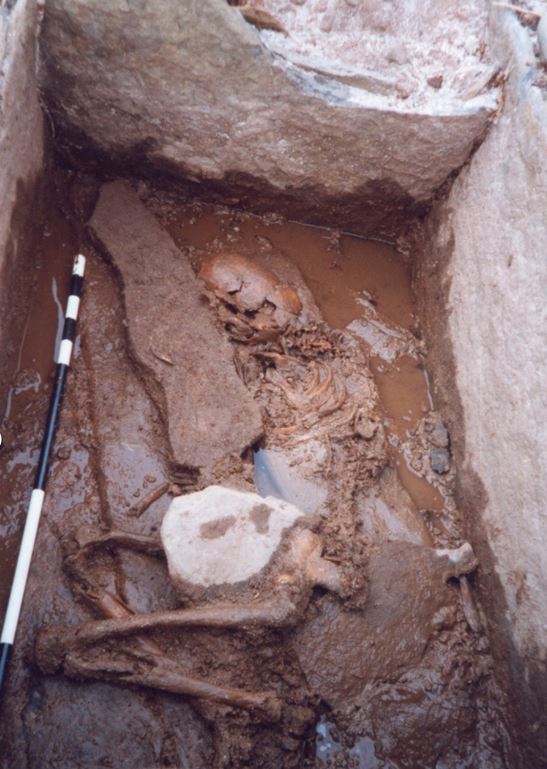
Orkney Woman in the Foreshore (Lorena Innes)

More Sea Urchins.  This is a news report from Past Horizons: "Cist in the Foreshore"

This is Early or Middle Bronze Age burial has a wide wiggle range, but it was probably an EBA burial.  The full archaeology report can be found here "ARO19: The Cist on the Foreshore at Lopness, Sanday, Orkney" by Lorna Innes  (search AR019)
Woman from Lopness on Sanday
The westward facing woman was a middle aged and had worked hard her whole life with some osteoarthritis in later years.  Her bones indicate some repetitive activity, so it's thought maybe mending fishing nets or textile work. 

Although there is no diagnostic pottery, there is in addition to sea urchins, lobster, fish bones, and two baby lambs. The radiocarbon date, taking other variables into account, is 1890 - 1520 B.C.  The grave roof appears to have collapsed, possibly during the lifetimes of those who buried her, and it was again filled through the crack with more offerings (if I am reading this correctly).

It sounds as if the burial was covered with a large mound of dirt from the inland.   Apparently this had nondescript pottery fragments and knapping debitage.  


You have to wonder if there was a special desire by the deceased to be buried by the sea just as someone might request today..?

What's remarkable about modern Orkney is that R1b and R1a constitute about 93% of male lineages.  If you assume that the large portion of R1a comes from Northmen, the highest percentage in the Isles, then must certainly accept that the majority, if not the totality of the 8% haplogroup I did as well. 

After removing that, what are we left with?  What components of Orkney or Shetland could represent the male posterity of the Neolithic?  It's may sound ludicrous, but it's looking like 0%.

The only other scenario that's halfway plausible is that the Orkney grooved ware tradition was in fact Western Iberian in origin and the island was overwhelming R1b prior to the Beaker advance.  If this was the case, then the R1b-ization of the Isles could have begun several hundred years before the Beaker times with the Grooved Tradition.  I don't lean this direction, just saying it's remotely plausible.

See the paper, lot of interesting thingsMore on the Neolithic excavations, see:

Orkney Jar

Wednesday, February 17, 2016

Ava of the Highlands (BBC)

From the BBC: "Effort to unlock secrets of 3,700-year-old woman 'Ava'"

Hat tip, Mandy Chamberlin!

When you read the BBC story, don't get wrapped around the axle of periodization.  This is a late Beaker burial, directly carbon dated to 3700 B.P.

It is a particularly interesting burial for a number of reasons.  I'll go by the numbers starting with the news story in the BBC.  As you can tell, this young woman was hyper-brachycephalic bordering on ultra-brachycephalic based on the measurements of archaeologist Maya Hoole, who's managing "The Achavanich Beaker Burial Project". (see website)


The Young Beaker Woman (modified, via The Achavanich Burial Project)

I've previously hypothesized that the already meso- to brachycephalic ethnic Beakers were intensely swaddled as infants using cradle boards, further deforming their heads in some cases.  Comparing the two women of Achavanich (Highlands) and Camino de Yeseras (Madrid) might be a useful place to start (scroll down on this post).

Before preceding, I'll give you my two cents on flatheads.  It is clear to people-not-on-drugs that there is an identifiable ethnic core to the pan-Euro-African Bell Beaker phenomenon and that these people are easily distinguishable from the local substrate, in terms of height, skull characteristics, teeth, toes, and now by ancient DNA, etc.

But it seems that some Beaker heads are also outside 'normal' dimensions, unless they all had some kind of congenital deformity, which is not likely.  That leaves environmental concerns as the likely cause of a flathead like Hoole illustrates for Achavanich girl below.
A Pancake Head! by Maya Hoole (modified, via The Achavanich Burial Project)

Part of why I'm confident Beaker babies were strapped to cradle boards is really fourfold.  The first is the deep paternal ancestry of Beaker men, which quite clearly takes us to North Asia where there is plenty of ethnographic examples on both sides of Beringa.  We can see similar occipital flattening in Mongolian or Navajo babies of varying intensity.

The second question is really about mobility.  Beakerfolk were not 100% copper-wielding, warrior men walking around like roosters.  They were all ages, but more often children and babies.
So when we talk about Beaker mobility we must remember who is mobile.  You will remember a post recently on disabled Beaker folk and you may remember that even the Amesbury archer was crippled and may have needed a walking cane since one of his knees was blown out.  We can at least solve the baby mobility problem.

Navajo Woman and Child (Commons)

Thirdly, Europeans have a long and rich tradition of border-line child abuse swaddling.  It's only been in the last century or two that old school swaddling has died out, although its still customary to tightly wrap an infant in blankets.  Really it comes down to cradle boards, intensity and folk beliefs which have varied in intensity.

Finally, intentional head deformation, as practiced on every continent by every people since the Paleolithic, aims to lengthen the skull.  Intentional skull deformation is often very dramatic and highly differentiated, not something requiring giant calipers. 

Lapp Family (UMD Sweden)
This leaves us with an elegant solution, that the folk beliefs of the Beaker culture encouraged binding infants to cradle boards to include the head.  Mongolians did this to increase the child's height and 'make them strong and upright'.  Europeans generally believed it helped build the character and keep them out of trouble.

If this was the case, it could complicate other aspects of research though.  One is that cradling has been linked to an increase in infant hip dysplasia and the malformation of the acetabulum.  These types of patterns may have been (instead) used to indicate frequent horseback riding in Germany.  I don't know if developmental and adult deformities are easily separated or not.

Now moving on to this oddly decorated beaker.  Some of it seems to have some Grooved Ware character with the palm leaf pattern.  It's considered remarkable by Hoole for the number of techniques used to create it. 
The Clarke N4 Short Neck Beaker (modified, via The Achavanich Burial Project)

And now for one last comment on the burial.  Within in rock-cut pit there was placed a cow scapula, which is the shoulder blade.  There is no mention or expectation that it was ever notched, however this particular bone was a common burial artifact among the 'Sea Peoples' with connections to Cyprus, among others.  I believe cow spatulas are also found in Iberia; I'll have to research this further.  Perforated cow spatulas are also found in Northern China.

It has been variously proposed that notched and un-notched scapulas were musical instruments (David S. Reese, 2002), either a harp body or possibly a sound board like a turkey slate*, except for musical purposes.  
A Sea Peoples Scapula
A little of topic, this website of the Sea Peoples epic, has a pretty good breakdown of Sea People groups. 

Overall, there's quite a bit of Bronze Age activity around Caithness, especially at Achavanich.

* a turkey slate is load friction based soundboard used for hunting turkeys in North America

Monday, February 15, 2016

Lager Yeast Not Ancient? What!

I read this on Science 2.0:  "Lager Yeast - Beer Making Microbe Gets An Origin Story"

Beakerblog!

It refers to this 2015 paper "The genome sequence of Saccharomyces eubayanus and the domestication of larger-brewing yeasts" as appeared last August in the Journal of Molecular Biology and Evolution. 

There's two basic styles of beer: Ales and Lagers.  Ale ferments around 65 (18 C) degrees and reaches final gravity usually in about two weeks.  Saccharomyces cerevisiae is the original Near Eastern cereal yeast for bread and beer.
 
Lagers are 'lagered' at a temperature close to 40 (4 C) degrees and since the yeast work slower lagering, finishing can take some time.  This yeast is Saccharomyces pastorianus, for a few years now recognized as a hybrid.  It produces a crisper, cleaner beer.  This accounts for about 95%~ of the world's crappy, mass-produced beers.

According to Baker et al's molecular clock estimate, the hybridization between Saccharomyces cerevisiae and Saccharomyces eubayanus creating Saccharomyces pastorianus (lager yeast) occurred about 500 years ago.

This timeframe might sound rather convenient given European contact with the Americas, but eubayanus has been found in Tibet, Mongolia and China within the last several years as well.  Lagering is also described as early as the 1300's so contact with the Americas would be too late to explain the birth of lager yeast.  Admittedly though, we're dealing with two secondary evidences 1) monks and 2) molecular clocks. 

Hopefully Making Beer
What I have always assumed is that Saccharomyces pastorianus (lager yeast) was native to Northern Europe and that the first farmers would have unknowingly promoted the more adapted native strains through constant brewing.  In other words, beer was sometimes unknowingly made with this yeast in Northern Europe for as long as beer has been made in Northern Europe, despite what it is called.

Because hybridization requires the presence of both components at the same place from the beginning, we can go ahead a cross Europe off the list of likely points of origin.  The Baker paper doesn't give a whole lot of wiggle room either, even if their estimate is too young.  So when and where did lager yeast develop?

The obvious location would be 1) an environment where S. eubayanus was native 2) that was also being settled by folks who cultivated cereals with naturally occurring s. cerevisiae.

Kind of sounds like the North Pontic-Caspian region, maybe Northwestern China.  The next question is age, not that yeast floating in the air require an archaeological context.  Whenever this question is sufficiently resolved, it may tells us a little more about prehistoric brewing.

It seems like the Corded Ware people, as one example, had beer year round to place in burials.  That means they either brewed year round and were able to control the primary fermentation temperature or were able to store large amounts of beer in barrels.  Or again...they were able to ferment in the lager range.


See also - German Beer Institute