 |
| Fot. M. Mackiewicz via PAP |

Wednesday, October 11, 2017
Silesian Beakers 2015
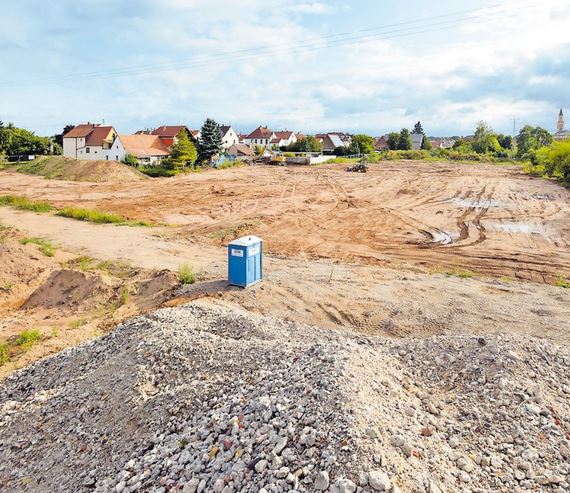
Two different groups of Polish Beakers that have yet to be genetically sampled are the Beakers of the Lowlands and then those of Silesia. Reading something else I happened to stumble on this story from Polish PAP.
We've already seen some Małopolskans some and I believe that more are coming from that group [this post].
Wednesday, October 4, 2017
Arroyal I in Burgos!!!
Here's a closer look at another grave examined in "The Beaker Phenomenon and the Genomic Transformation of Northwestern Europe". [here]
(I previously wrote Burgos was in Catalonia. It's like 4 hours from there! Thank you Cesar and Olalde!)
Eduardo Camerona twitter
In the Ballestro et al paper linked below they figure that Arroyal I faces East overlooking the Ubierna River Valley and the town of Arroyal. I snipped this photo from Google maps on Calle San Antonio from the church, Ermita de San Antonio Abad. Unfortunately it ends at the windmill easement dirt road, but you can see looking WSW (West South West) that the burial mound was perched at the highest point looking straight back at an elevation of 967 meters. I'll extract a few items from the Ballestro paper to give additional context to the Olalde paper below:

Previously a dolmen, the tomb of Arroyal I was modified from a collective space into a burial mound for the first Beaker girl. Being the earlier of the two girls, I0462 (UE 25) was located in Phase 4 of the tomb and was probably associated with two nearby bell beakers of the international maritime style and two serving dishes. She was [K1a+195].
Later in the Beaker period was buried I0461 (UE 19) and she was [K1a1b1]. Her burial was in a pit grave stone box and she had with her ciempozuelos, but also some fragments of maritime style.
Previous to the individual burials of these girls (at different times), a large number of highly fragmented human remains were uncovered from the older layers. They appear to be associated with the precampaniforme pottery style. Another important difference noted in the Olalde paper is the presence of steppe-like ancestry in the girls, but not the previous occupants. The earlier girl has more steppe-like ancestry and the latter less, which might be expected if foreigners are melded with the local population.
One important distinction between the two girls is that the earlier was buried in the chamber and represents the last grave of that sequence, possibly the only one depending on the purpose of being surrounded by skulls and bones (not sure I'm fully understanding that). The second girl, maybe considerably later was buried in a pit grave, almost the way additional pits might be added to an old kurgan.
If I find photos of the graves at some point in the future I'll update this post.
See Also
"El dolmen de Arroyal I: usos y modificaciones durante el III milenio cal AC." Ballestero, Arnaiz, Alameda Cuenca-Romero [Link]
"El campaniforme internacional en el dolmen de Arroyal I (Quintanadueñas): estudio estilístico y analítico de los restos arqueológicos" Gonzalo de Pedro Andrés
(I previously wrote Burgos was in Catalonia. It's like 4 hours from there! Thank you Cesar and Olalde!)
 |
| From website of Eduardo Camerona, archaeologist (commons) |
In the Ballestro et al paper linked below they figure that Arroyal I faces East overlooking the Ubierna River Valley and the town of Arroyal. I snipped this photo from Google maps on Calle San Antonio from the church, Ermita de San Antonio Abad. Unfortunately it ends at the windmill easement dirt road, but you can see looking WSW (West South West) that the burial mound was perched at the highest point looking straight back at an elevation of 967 meters. I'll extract a few items from the Ballestro paper to give additional context to the Olalde paper below:

Previously a dolmen, the tomb of Arroyal I was modified from a collective space into a burial mound for the first Beaker girl. Being the earlier of the two girls, I0462 (UE 25) was located in Phase 4 of the tomb and was probably associated with two nearby bell beakers of the international maritime style and two serving dishes. She was [K1a+195].
Later in the Beaker period was buried I0461 (UE 19) and she was [K1a1b1]. Her burial was in a pit grave stone box and she had with her ciempozuelos, but also some fragments of maritime style.
Previous to the individual burials of these girls (at different times), a large number of highly fragmented human remains were uncovered from the older layers. They appear to be associated with the precampaniforme pottery style. Another important difference noted in the Olalde paper is the presence of steppe-like ancestry in the girls, but not the previous occupants. The earlier girl has more steppe-like ancestry and the latter less, which might be expected if foreigners are melded with the local population.
One important distinction between the two girls is that the earlier was buried in the chamber and represents the last grave of that sequence, possibly the only one depending on the purpose of being surrounded by skulls and bones (not sure I'm fully understanding that). The second girl, maybe considerably later was buried in a pit grave, almost the way additional pits might be added to an old kurgan.
The site of Arroyal I was excavated by a research team from the University of Burgos in
2011–2012. The site is a megalithic grave with well-preserved structural elements: a
rectangular chamber (3x3.5 m), a long corridor (6 m), and a stone mound. The grave
was used as a collective burial during 400 years in the Late Neolithic (3300–2900
calBCE)19. The grave was then abandoned until the Chalcolithic when it was
extensively remodelled: Neolithic layers were almost eliminated; the corridor was filled
with rocks and sediment; the useful area inside the chamber was reduced when a stone
wall was built; and a floor of limestone blocks was built inside the chamber. Several
consecutive and isolated burials (9–10) were then introduced. The last one (Roy5) was a
young individual buried with a set of 4 vessels (2 Bell Beakers [international maritime style and 2 carinated bowls) and surrounded by the long bones and skulls from previous burials. She represents the earliest observation of steppe-related genetic affinities in the Iberian Peninsula. Then the dolmen was closed using materials from the site (in secondary position) and, at the same time, the mound height was increased. Finally, an isolated pit grave (Roy4) was made inside the mound. We successfully analysed 5 individuals from this site:
I0458/Roy1/SU25, Skull 1: 2458–2206 calBCE (3850±30 BP, UGA-15904)
I0459/Roy2/UE25, Isolated human jaw: 2600–2200 BCE
I0460/Roy3/SU25, Skull 2: 2461–2210 calBCE (3860±30 BP, UGA-15905)
I0461/Roy4/SU19, Inhumation 1: 2348–2200 calBCE (3827±25 BP, MAMS-14857)
I0462/Roy5/SU25, Inhumation 2: 2465–2211 calBCE (3870±30, UGA-15903);
2566–2346 calBCE (3950±26 BP, MAMS-25936)
Samples Roy1 and Roy3 were genetically first-degree relatives and belonged to
different mitochondrial haplogroups, which points to a father-son relationship.
 |
| From Fig S1 |
"El dolmen de Arroyal I: usos y modificaciones durante el III milenio cal AC." Ballestero, Arnaiz, Alameda Cuenca-Romero [Link]
"El campaniforme internacional en el dolmen de Arroyal I (Quintanadueñas): estudio estilístico y analítico de los restos arqueológicos" Gonzalo de Pedro Andrés
Monday, October 2, 2017
Discovery - Lingenfeld Glockenbecher
Die Rheinpfalz reports the discovery of a Glockenbecher burial during the construction of a new building.
The discovery comes from the town of Lingenfeld, south of Spayer in Rhineland-Palatinate. It's fairly close to the Rhine River.
This photo was taken from an inlet street of Neustadter Street of the same name. You can see the back of the steeple of the Catholic Church in the upper right. Unfortunately, google maps doesn't have a streetview available of the main Neustadter Street. The aerial photo still shows the old sawmill.
The only publication that's reported on this find is Rheinpfalz. I can make out what looks like what was a bag at his feet, I guess. He has a beaker behind the head and by that a cluster of something. It looks like his left arm may have a bracer, but it's hard to tell since his arms are piled up. His head looks to the rising sun slightly to the northeast, so maybe he died in the wintertime?
The Long-legged Lingenfelder? Couldn't think of anything that rhymes.
 |
| Landesarchäologie via Rheinpfalz |
The discovery comes from the town of Lingenfeld, south of Spayer in Rhineland-Palatinate. It's fairly close to the Rhine River.
 |
| Photo from Lenz via Rheinpfalz |
The only publication that's reported on this find is Rheinpfalz. I can make out what looks like what was a bag at his feet, I guess. He has a beaker behind the head and by that a cluster of something. It looks like his left arm may have a bracer, but it's hard to tell since his arms are piled up. His head looks to the rising sun slightly to the northeast, so maybe he died in the wintertime?
The Long-legged Lingenfelder? Couldn't think of anything that rhymes.
Tuesday, September 26, 2017
DNA - The Violet Volken? (Fregel et al, 2017)
Something curious is afoot. New questions emerge from this paper.
I guess I've mis-understood the Ifri n'Amr o'Moussa cave site from the outset unless it's been re-dated, it seems that all of the human remains buried here (facing NS and EW) are dated to be Cardial Farmers more than likely, not associated with the Beaker materials of this cave. If I understand correctly, no human remains in this cave can be attributed to the Beaker period. These samples are called IAM after the excavation, and they look like a mixture of early farmers and native people.
The second site of Kehf el Baroud is the site that raised my antennas. These samples are called KEB and come from a white layer dated to around 3200-3000, right below the grey Beaker horizon. This archaeological layer is associated with a pottery tradition that some have described as proto-Beaker, including (Daugas et al, 1989) or more often 'influences' from here can be seen on the later ceramic.
During this time, extensive trade is occurring between the Portuguese castillos, Southern Spain and nearby burial sites like Rouazi-Skhirat and El Kiffen. (also The Ivory Road) Now a genetic relationship and population movement can be demonstrated as well. In fact, based on the mtdna profiles and comments in this draft, it looks something short of population turnover with people coming from Iberia at some point before the LN.
KEB is, to some degree, a combination of a previous Moroccan mix with a strong and distinctly European vein that is suggestive of a SW European expansion, and curiously they specifically mention this 'violet component' rise in Middle Neolithic Central Europe with Baalberge and Salzmunde, which they see as moving from SW Europe. Another distinct part of those and Michelsberg was a spike in WHG ancestry emanating from the Paris Basin and probably further south, although there are 'steppic' or SE European elements as well . See previous post.
Remember that the results below are from only two Moroccan caves so it's definitely not the full picture, but interestingly haplogroup H is missing from the Mesolithic/Early Neolithic 'native' set. Keeping in mind it's only one cave, it still seems significant because it's there in modern times, among some Saharan and Atlas Berbers in spades.
 If there were more bodies to test from the pre-Beaker and Bell Beaker period, it's likely that one or both could have some M269. It's definitely there by the first millennium. Canary Islander DNA from the first millennium.
BTW, read the last four page of Background to Beakers beginning on page 196. Pretty impressive.
Yussaef Bokpot previously did a translatable Arabic interview [here]
Abstract:
I guess I've mis-understood the Ifri n'Amr o'Moussa cave site from the outset unless it's been re-dated, it seems that all of the human remains buried here (facing NS and EW) are dated to be Cardial Farmers more than likely, not associated with the Beaker materials of this cave. If I understand correctly, no human remains in this cave can be attributed to the Beaker period. These samples are called IAM after the excavation, and they look like a mixture of early farmers and native people.
The second site of Kehf el Baroud is the site that raised my antennas. These samples are called KEB and come from a white layer dated to around 3200-3000, right below the grey Beaker horizon. This archaeological layer is associated with a pottery tradition that some have described as proto-Beaker, including (Daugas et al, 1989) or more often 'influences' from here can be seen on the later ceramic.
During this time, extensive trade is occurring between the Portuguese castillos, Southern Spain and nearby burial sites like Rouazi-Skhirat and El Kiffen. (also The Ivory Road) Now a genetic relationship and population movement can be demonstrated as well. In fact, based on the mtdna profiles and comments in this draft, it looks something short of population turnover with people coming from Iberia at some point before the LN.
KEB is, to some degree, a combination of a previous Moroccan mix with a strong and distinctly European vein that is suggestive of a SW European expansion, and curiously they specifically mention this 'violet component' rise in Middle Neolithic Central Europe with Baalberge and Salzmunde, which they see as moving from SW Europe. Another distinct part of those and Michelsberg was a spike in WHG ancestry emanating from the Paris Basin and probably further south, although there are 'steppic' or SE European elements as well . See previous post.
 |
| IAM girl with millstone? Moroccan Press |
Remember that the results below are from only two Moroccan caves so it's definitely not the full picture, but interestingly haplogroup H is missing from the Mesolithic/Early Neolithic 'native' set. Keeping in mind it's only one cave, it still seems significant because it's there in modern times, among some Saharan and Atlas Berbers in spades.

"By 3,000 BCE, a European Neolithic expansion brought Mediterranean-like ancestry to the Maghreb, most likely from Iberia. Our analyses demonstrate that at least some of the European ancestry observed today in North Africa is related to prehistoric migrations, and local Berber populations were already admixed with Europeans before the Roman conquest. Furthermore, additional European/Iberian ancestry could have reached the Maghreb after KEB people; this scenario is supported by the presence of Iberian-like Bell-Beaker pottery in more recent stratigraphic layers of IAM and KEB caves."And here something interesting
"At K=8, a new violet component is majoritarian in Iberian Neolithic_EN and most Europe_MNChL, splitting from the early farmers green component. Europe_MNChL samples that posses 100% of the violet component include Early/Middle Neolithic and Chalcolithic sites from Iberia, Middle Neolithic sites from Germany (Baalberge and Salzmuende cultures) and a Chalcolithic site from Italy (Remedello culture) (Figure S7.4). This result could indicate an, at least partial, Iberian component in Middle Neolithic and Chalcolithic populations in Germany and Italy."And the dating of Kehf el Baroud
"The human remains analyzed in this study were obtained from the white layer, whoseI'm still puzzled by the presence of V88 in the Sahel. I figured it'd be present among the Cardium/Impresso peoples, but that hasn't panned out so far. Maybe it comes from Iberia with Beakers or MN Iberians?
pottery remains are quite similar to Late Neolithic and Early Chalcolithic pottery from
other locations in Morocco, such as the two neighboring necropolis of Rouazi-Skhirat and El Kiffen, and from Spain and Portugal, primarily in Los Millares and Vila Nova de Sao Pedro. The dating of the white layer performed by De Wailly13, giving an age of about 3,200 BCE, has been disputed by most researchers. However, this date has been confirmed previously by thermoluminescence12 and by calibrated radiocarbon dating in this study (Table S1.1, Figure 1.4)."
 |
| "Background to Beakers" page 196 |
BTW, read the last four page of Background to Beakers beginning on page 196. Pretty impressive.
Yussaef Bokpot previously did a translatable Arabic interview [here]
Neolithization of North Africa involved the migration of people from both the Levant and Europe
Supplement 1Abstract:
One of the greatest transitions in the human story was the change from hunter-gatherer to farmer. How farming traditions expanded from their birthplace in the Fertile Crescent has always been a matter of contention. Two models were proposed, one involving the movement of people and the other based on the transmission of ideas. Over the last decade, paleogenomics has been instrumental in settling long-disputed archaeological questions, including those surrounding the Neolithic revolution. Compared to the extensive genetic work done on Europe and the Near East, the Neolithic transition in North Africa, including the Maghreb, remains largely uncharacterized. Archaeological evidence suggests this process may have happened through an in situ development from Epipaleolithic communities, or by demic diffusion from the Eastern Mediterranean shores or Iberia. In fact, Neolithic pottery in North Africa strongly resembles that of European cultures like Cardial and Andalusian Early Neolithic, the southern-most early farmer culture from Iberia. Here, we present the first analysis of individuals' genome sequences from early and late Neolithic sites in Morocco, as well as Andalusian Early Neolithic individuals. We show that Early Neolithic Moroccans are distinct from any other reported ancient individuals and possess an endemic element retained in present-day Maghrebi populations, indicating long-term genetic continuity in the region. Among ancient populations, early Neolithic Moroccans share affinities with Levantine Natufian hunter-gatherers (~9,000 BCE) and Pre-Pottery Neolithic farmers (~6,500 BCE). Late Neolithic (~3,000 BCE) Moroccan remains, in comparison, share an Iberian component of a prominent European-wide demic expansion, supporting theories of trans-Gibraltar gene flow. Finally, the Andalusian Early Neolithic samples share the same genetic composition as the Cardial Mediterranean Neolithic culture that reached Iberia ~5,500 BCE. The cultural and genetic similarities of the Iberian Neolithic cultures with that of North African Neolithic sites further reinforce the model of an Iberian intrusion into the Maghreb.
Tuesday, September 19, 2017
Michelsberg-Pfahlbaukultur, Alpine Cattle & CWC
Rick Hern just posted this interesting [link] in an old Beakerblog post concerning bos longifrons. Although the studied animal only represents what Basal researchers call 'small cattle', it is worth pointing out that longifrons/brachyceros is dated earliest in the Swiss lakeside pile dwellings. Though this is only a mitochondrial study, it could foreshadow increasing validity of those early archaeozoological observations. They do notice that the size of the cattle is coincidentally similar to Swiss Rhaetian Greys, Tyroleans long considered longifrons since Adamtz (NPI). I'll pause here momentarily..
Let's continue peeling the onion from two posts ago and revisit a recent genetics paper that involved a mysterious folk and then pivot from there: "Multi-scale ancient DNA analyses confirm the western origin of Michelsberg farmers and document probable practices of human sacrifice" by Beau et al, 2017
In that paper the MN Gougenheim (Alsace) burial site contained two different peoples, those who were sacrificed and tumbled into a pit (NCV), and those with a high status pit burial (CV), like the Beaurieux warrior below. They are isotopically identical. This is what Beau et al observed:
We've already seen a few Michelsberg derived or influenced groups with the male signature of, surprisingly, R1 or R1b (Baalberge and Blatterhohle I1594 & I1593), and they also oddly enough distinguish themselves for considerable WHG ancestry (Lipson et al, 2017, Supp Info). Up to this point, the re-emergence of WHG in the MN has been, fairly reasonably, viewed as the consolidation of farmer majorities with hillbilly hunters in the margins of Europe. If gory Gougenheim represents a larger phenomenon, perhaps simple gene flow is a weak explanation.
With regard to the rapid increase of H clades in Central Europe during the LN, two different hypotheses have been put forward. Brotherton et al, 2013 proposed that H1 and H3 came from SW Europe during the LN. Hervella et al, 2015 proposed this rise to a second Neolithic wave originating in NW Anatolia and transmitting to Central Europe via the Central Balkan Peninsula. Comically, Michelsberg has 'heritage' it seems from both directions, but it is more plausible that at least its maternal basis originates in the South of France. Still waiting Dulias et al, 2017...
Michelsberg emerges at a time when morphologically domestic horses (very large and very small) are becoming established in Continental Europe among several different cultures, 4k to 3k B.C. "Horse size and domestication: Early equid bones from the Czech Republic in the European context" (Kysely and Peske, 2016)
Michelsberg was a drinking culture that, like Beakers, also made bothroi sacrifices, "Un dépôt de céramiques Michelsberg à Obernai « Parc d’activités économiques intercommunal" by Lefranc and Feliu, 2015
For the first time there is deep flint mines, which is where brachycephalic "Rijckholt I" died. Point-based pottery is a strange regression, potentially a indication of new mobility. Salzmundians seem to have had a dogster phenomenon like CA Iberia, where I believe hunter ancestry also spikes.
Who knows what Horgen DNA looks like; it probably doesn't matter much anyway. But if pockets of elite hunter-farmers established themselves in pockets of the Western Alps and the Upper Rhine, and if those elites were R1b, then those LN pile dwelling cattle just might make sense after all.
Full circle again - one of Maju's posts
Let's continue peeling the onion from two posts ago and revisit a recent genetics paper that involved a mysterious folk and then pivot from there: "Multi-scale ancient DNA analyses confirm the western origin of Michelsberg farmers and document probable practices of human sacrifice" by Beau et al, 2017
In that paper the MN Gougenheim (Alsace) burial site contained two different peoples, those who were sacrificed and tumbled into a pit (NCV), and those with a high status pit burial (CV), like the Beaurieux warrior below. They are isotopically identical. This is what Beau et al observed:
"Whereas all "H-G lineages" (of potential western origin) were found concentrated in the NCV group, the CV group contained a strong proportion of haplogroups H (H, H1 and H3) and X, which were more common in southern European and Paris Basin farmers"Basically, you have typical farmers on one hand, and then the H1, H3 and X folks on the other.
 |
| Michelsberg Warrior (Manolakakis, Colas, Thevenet, 2007) |
We've already seen a few Michelsberg derived or influenced groups with the male signature of, surprisingly, R1 or R1b (Baalberge and Blatterhohle I1594 & I1593), and they also oddly enough distinguish themselves for considerable WHG ancestry (Lipson et al, 2017, Supp Info). Up to this point, the re-emergence of WHG in the MN has been, fairly reasonably, viewed as the consolidation of farmer majorities with hillbilly hunters in the margins of Europe. If gory Gougenheim represents a larger phenomenon, perhaps simple gene flow is a weak explanation.
With regard to the rapid increase of H clades in Central Europe during the LN, two different hypotheses have been put forward. Brotherton et al, 2013 proposed that H1 and H3 came from SW Europe during the LN. Hervella et al, 2015 proposed this rise to a second Neolithic wave originating in NW Anatolia and transmitting to Central Europe via the Central Balkan Peninsula. Comically, Michelsberg has 'heritage' it seems from both directions, but it is more plausible that at least its maternal basis originates in the South of France. Still waiting Dulias et al, 2017...
Michelsberg emerges at a time when morphologically domestic horses (very large and very small) are becoming established in Continental Europe among several different cultures, 4k to 3k B.C. "Horse size and domestication: Early equid bones from the Czech Republic in the European context" (Kysely and Peske, 2016)
Michelsberg was a drinking culture that, like Beakers, also made bothroi sacrifices, "Un dépôt de céramiques Michelsberg à Obernai « Parc d’activités économiques intercommunal" by Lefranc and Feliu, 2015
For the first time there is deep flint mines, which is where brachycephalic "Rijckholt I" died. Point-based pottery is a strange regression, potentially a indication of new mobility. Salzmundians seem to have had a dogster phenomenon like CA Iberia, where I believe hunter ancestry also spikes.
 |
| Fig 30 Rijckholt I skull |
Full circle again - one of Maju's posts
 |
| Rhaetian Grey (Swiss Info) |
Subscribe to:
Posts (Atom)