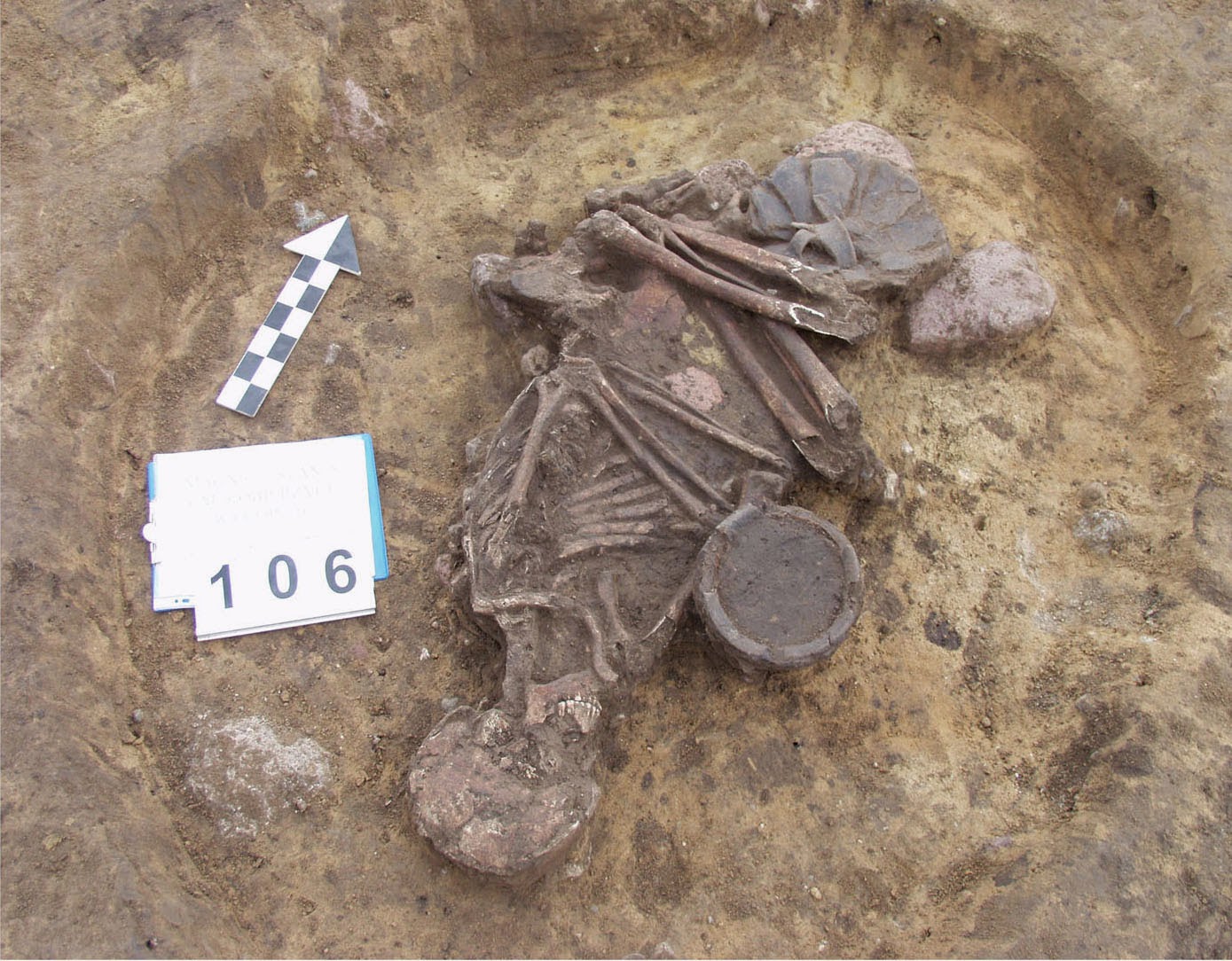
The two burials examined in this paper solidify previous research on Beaker family connections and social practices. Here, a boy and girl are buried with close female relatives. See also Phys.org
A previous post on the Dunstable Down burial [here] looked at the echinoid phenomenon; interestingly Altwies was surrounded by "...a stone ‘ring’, possibly made of fossilized shell..." (Le Brun-Ricalens, 2011) The similarities of these British and Continental graves made the possibility of some kind of rite a question of interest.
The young girl was buried with her paternal aunt, a woman plausibly young enough to have been unmarried, an important point due to the long-distance female exogamy of this population. The boy was buried with his mother. Both pairs had substantial Steppe ancestry and share closeness with populations of Bohemia, although some interpretive caution is advised.
Table 1 (so is it H5c or H33c?)
Most adult-child burials across Eurasia will prove to be children of close female relatives. Occasionally non-related women may be buried with children and then it's fair to ask why. But if we're going to ask why, let's not immediately jump to the least likely of all possibilities!
"A young adult woman, who had a typical ancestry of the Iberian Peninsula, was buried atop the skeleton of an infant girl in an artificial cave. The infant was neither her daughter nor a close biological kin, but had a comparatively high amount of steppe ancestry27,82,83. We may speculate that kinship practices were different in the southern domain of the Bell Beaker culture, where collective burial traditions in megalithic tombs and artificial caves continued uninterrupted"
What?? Why is placing the body of a young dead woman over the body an infant evidence of uninterrupted megalithic burial tradition? The young woman likely had one of two relationships with the infant. 1) She was by family marriage an aunt, cousin or older step-sister to the infant and added weeks after the first burial for whatever netherworldly reasons, 2) She was sacrificed and placed on top of the first grave. I think the second option is unlikely because the baby was both and infant and a girl. Probably, it was just a sad misfortune of two deaths and it made sense to bury a baby and woman together.
Do these burials point to a patriarchal society as the authors suggest? To the degree that we can speculate without further evidence, probably so.
Although ALW2 was a boy of only 3-4 years old, his maleness is emphasized in this combined grave. It's important to note nearby grave 1 (with no dna) could have been his young father. Perhaps as sole male survivor of his young father's house, his social position was more meaningful to his mother and to those than knew them. I recall a paper on idealized Czech child burials by Jan Turek, (I'll update when I find it).
For LUT1 (aunt), to be within close proximity of her brother's family would likely mean she was unmarried. She would have been within the median range of first marriage for girls in Europe historically, so it's plausible. This, in theory, reinforces the patrilocality of this community.
Zedda, N., Meheux, K., Blöcher, J. et al. Biological and substitute parents in Beaker period adult–child graves. Sci Rep 13, 18765 (2023). https://doi.org/10.1038/s41598-023-45612-3
I think I've healed enough from my seven or eight divorces to get into this again. Beakerblog may develop into a channel this year. I will have to explore the possibilities since I don't live in Europe and it is difficult when the topic is quintessentially European . The important thing is to do and blog about what I enjoy. I look forward to the months ahead.
Well, the new Anglo-Saxon paper is out and it is another notch in the belt for the ancient historians.
I'll be watching to see what the refined quantities of post-Saxon French turn out to be.
Eleanor and Henry Plantagenet
I've thought for a long time estimates on French settlement were too low. After all, how can two countries be politically unified for so long without significant mobility?
I've scoured papers, forums and blogs, and weirdly to no one does it seem important that losing 40,000 square miles* around the time of a great admixture event seem worth mentioning.
A vast plateau of swamps, sand dunes, peat bogs, deserts and alluvial plains wiped out in a matter of generations. And the people? Can we assume people lived there as most humans of our past lived within a few miles of a major water feature? Then came salinization.
Does anyone think it might be important to how two peoples crash into each other?
Potsherds from a few vessels with Cardium decoration were recently found in old collections of some Neolithic sites of the Northern Black Sea area. A good samples of the valves of brackish water ostracods were discovered in the raw material in most of these vessels. This could indirectly indicate the presence of Neolithic settlements with Cardium pottery on what is now a flooded region of the northern Black Sea coast. Some data show that its inhabitants could have been the initial source of the Neolithisation of neighbouring inland territories. Thus, the whole local Neolithic in the region is interpreted as a northeastern branch of the Mediterranean Neolithic with Impresso and Cardium pottery
Update 3. FrankN wrote this in 2019 "How did CHG get into Steppe_EMBA? Part 2: The Pottery Neolithic" He poopoos on Dmytro Gaskevych's idea that Mediterrean-based Impresso folks settled the area based on adna. Given that Circum-Mediterrean Impresso peoples are probably very heterogenous, I think fairly weak argument. It's a matter of which enclave produced the stream of settlers.
Reading further though, some agreement on the presence of CHG in the North Black Sea. Very reason to think it was more prominent across the ancient northern Black Sea, than just the 1/3 northeasternly portion where we know it was abundant.
Another lunar landing controversy. In 2020 a new claim was made doubting the Sky Disk narrative.
To be clear, the Sky Disk is thought by mainstream archaeologists to have been created within the context of the Unetice Culture (and very locally within Central Germany). It has enough odd features to keep people talking, so let's dive right in.
But first, a pre-2019 everything-you-ever-wanted-to-know about the Nebra Sky Disk from Archaeosoup, including the original pre-2020 doubters...
The two German scientists try to make the case that the Sky Disk is an archaeological oddballonly because it doesn't belong to the Bronze Age Nebra hoard site. They argue that the disk becomes less of a weirdo when rightfully placed in the Celtic Iron Age of the local area.
And of course, Nebra supporters Harald Meller and Ernst Pernicka's fire back... "Why the Nebra Sky Disk Dates to the Early Bronze Age. An Overview of the Interdisciplinary Results" Meller and Pernicka review the preponderance of evidence exhaustively; how the disk was found, the significance of the site, why it is unlikely to be an Iron Age object based on current interpretations. They reply point by point, which I find very reasonable. But the doubters have gained traction, and so the discussion has become very heated.
One argument Gebhard and Krauss make is that the isotopic character of the disk differs from the other metallic Nebra hoard objects, and this being unusal for Bronze Age hoards, is a red flag for dating. They also focus on the looter testimony regarding the supposed orientation of the disk as it was struck with the looter pick axe. Gebhard and Krauss think that the puncture damage is not consistent with the testimony about how it was supposedly oriented when hit.
In their view a simple explanation awaits - the looters are lying about which looter dig site the disk came from, had financial incentive to do so, and by-the-way, are lying theives. The authors even go so far to suggest that the state's archaeologist was played and placated by two sly floxes that told him what he wanted to hear in exchange for liniency. This is probably the most direct slight, as they insinuate Meller's idea of a sophisticate Unetice principality in this area is nothing more than a boyish fantasy. Not just that Meller's interpretation of the area's Bronze Age is inflated, but that his pet theory obscured his understanding of the facts.
Harald Meller
Countering this, Meller and Pernicka point out that the Sky disk had a developmental history where things were added, moved and removed. The sequence suggests the disk was remanufactured and repurposed several times. As you see below, in one particular modification the disk was perforated around the edge and through the lower arc, which was added after moving one of the gold stars in its way. The development of the disk wasn't within a single manufacturing phase, but it was put to use and later refashioned numerous times with isotopically different metals in a drawn out period of time, perhaps generations. The fact that it does not match the metal artifacts of the Nebra hoard is inconsequential because its isotopic profile would not have matched anything, in any context, of any period.
Meller and Pernicka continue with the exhaustive testimony, reinactment, and all the scientific analysis of the site. It's technical, so you can read that for yourself. Let's return to the Unetice Culture's abilities in a moment.
Whatever its original purpose, by the time it was buried it may have decorated an ornamental shield.
(Fantastic paper Pasztor and Rozlund, 2007) It was plaustibly a
religious standard or sacral ornament and eventually passed down and
repurposed as a boss on a heroic shield. And if you have trouble with
that, read an excerpt from Pasztor and Rozlunds paper quoting Homer's
description of Achilles's celestial shield, song XVIII, lines 478-479 of the Iliad.
First fashioned he a shield, great and sturdy, adorning it cunningly in every part, and round about it set a bright rim, threefold and glittering, and therefrom made fast a silver baldric. Five were the layers of the shild itself; and on it he wrought many curious devices with cunning skill. Therein he wrought the earth, therein the heavens, therein the sea, and the unwearied sun, and the moon at the full, and therein all the constellations wherewith heaven is crowned - the Pleiades, and the Hyades and the mighty Orion, and the Bear, that men call also the Wain, that circleth ever in her place, and watcheth Orion, and alone hath no part in the baths of Ocean.
Given some similarities between Achille's shield and the Nebra Sky disk (likely part of a shield), let's transition to interpretation of the disk...
On the left, Ursa Major (great bear) faces the direction of Orion (not shown), at his feet Eridanus. Lupus (the wolf) hangs over Pleiades and over all else, not insignificant for imagery involving death and the solstices. Ursa Major does not descent below "the water", or a water line on the boat.
Pleiades, which is often subject to lunar and inner-planetary occulations, sandwiches Mercury, Venus and Mars, opposite the Moon because of its distance to the ecliptic. It was at heliacal rising in ancient times peaking around Halloween.
We have two firmaments with a solar boat transitioning from the right side to the left side, towards the Sun. I assume the bronze patina would have originally been dark, highlighting the gold and giving the impression of a night sky.
So is the imagery of a solar boat transitioning across the sky consistent with Iron Age Celtic fascinations or something much older? By the Late Bronze Age it seems that solar boats (death ferries, whatever) were being superceded by another celestial vehicle. That's not too different from a general trend Crecganford discusses in the previous post regarding the disappearance of an active solar/death boat in Indo-European religions generally. So although Meller didn't explicitly state this, I think his argument of the Sky Disk being part of an older motif fits the same model.
In the La Tène period, only six stars of the Pleiades were visible, as the Greek astronomer Aratos of Soloi (c. 310– 245 BC) testifies in his Phainómena (celestial phenomena):“Close to his (i.e. the constellation Perseus’) left knee, all the Pleiades travel in a swarm. The place, which is not very large, holds them all, and they are only faintly visible. Seven pathways are called those among the people, although only six of them can be seen with eyes. After all, the star was not lost without news from the house of Zeus, after we heard about its creation, rather it is spoken of in exactly the same way.”
Again, you may look at all the gold dots and see naked ladies, but it appears that Pleiades lost visibility of its seventh star by the Iron Age, or at least in the popular imagination and lore of Iron Age peoples of Europe.
Nevertheless, it is important to note that the ship in particular, which was added in phase III of the Sky Disc,125 is an element that does not appear in the Iron Age but is a central motif of the Bronze Age.12
And the key word here is "central motif". Like the Trundhold Chariot, and new motif had really begun to occupy the minds of Iron Age people, the idea of solar chariots. Now we can see that it had already taken root in Late Bronze Age Scandinavia. Given the solar crosses of the Beaker period, it's not impossible that it was already developing as a motif at that time in parallel with, or budding from, solar boats.
The holes around the perimeter suggest it was attached to a support of some kind, but at 2kg the disc is perhaps too heavy to be worn. It could, however, have been nailed to a shield or standard made of wood. In song XVIII, lines 478-89 of the Iliad, Homer describes in detail how Hephaestus makes a shield for the great hero Achilles: ‘First fashioned he a shield, great and sturdy, adorning it cunningly in every part, and round about it set a bright rim, threefold and glittering, and therefrom made fast a silver baldric. Five were the layers of the shield itself; and on it he wrought many curious devices with cunning skill. Therein he wrought the earth, therein the heavens, therein the sea, and the unwearied sun, and the moon at the full, and therein all the constellations wherewith heaven is crowned – the Pleiades, and the Hyades and the mighty Orion, and the Bear, that men call also the Wain, that circleth ever in her place, and watcheth Orion, and alone hath no part in the baths of Ocean’.
Here, it is important to point out that Achilles' shield is lamenated with numerous layers of animal skin that support this metallic motif. The Yetholm Shield below is probably an example of how the metal was used as the final layer in a build up, for appearance and weight savings, but importantly for effectiveness (composite skin layers being the most effective at stopping projectiles)
Yetholm-type_shield
Back to the idea of Unetice Principalities...
Harald Meller has written about the
larger society in which the Sky Disk emerges. It is a society that is
doing very large things. There is the contemporary Bornhock mega-mound, which might have some similarity to Silbury Hill in Britain.
Likely indications for fairly large and organized military units.
Principalities. See "Princes, Armies, Sanctuaries: The Emergence of Complex Authority in the Central German Unetice Culture"
Also, I previously blogged about the Dermsdorf barracks. To me, Meller's ideas are total genius, replicatible and make sense anthropolgically.
But I think one of the most important aspects of the Sky Disk that has not been discussed...and why it should date to the Early Bronze Age instead of a later period. It is that the Unetice People of that era were buried like this...