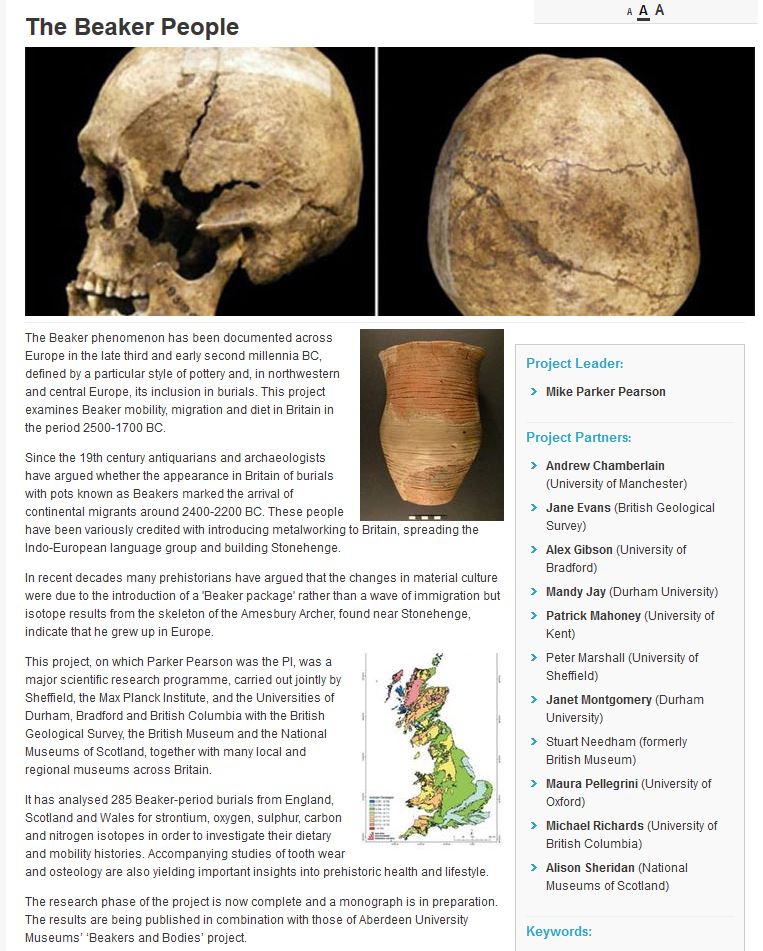
After a long wait... the results of the British mobility project are published. Hat tip Eurogenes.
First of all, I'd like to thank the authors for putting this article up at the Durham University site
[here]. I know this will be appreciated by many, especially given the importance of the work.
The legal hurdles of destructive testing on human remains are probably
significant enough that multiple tests might be performed at a strike.
Isotopic and radiocarbon studies seem to precede genetic ones, so I'm
hopeful that there will be some amount of DNA to follow. Nevertheless, this one paper is, in of itself, a very big paper covering almost 300 individuals in the Beaker period.
 |
| Excerpt from University College London (UCL) Project Page* (extracted 5/2016 [Link]) |
I'll point out some items of interest and go from there.
Head shape:
Significant craniometric differences were observed between those individuals of the Early Neolithic and this Beaker period population. Mostly expected.
And this:
"Certain individual skulls exhibited occipital flattening, a cranial modification probably caused by infants lying flat on their backs or being secured to a cradle-board."
And this:
"In contrast, two Neolithic period skulls exhibit artificial cranial deformation resulting from infant head-binding to produce long skulls."
Mamas!
Obviously, I agree with most of this, unless if intended to be a sole explanation:
"This evidence for artificial skull deformation was recognized at the time of excavation (Bateman 1861; Wilson 1863: 273–4) but has been largely forgotten; it goes some way to resolving the long-term debate about the existence of racial types of brachycephalic Bell Beaker people and dolichocephalic Neolithic people across many parts of Europe (Abercromby 1912; Childe 1925: 90; Brothwell 1960; Brothwell & Krzanowski 1974; Gerhardt 1976; Brodie 1994) by introducing a cultural explanation for some of these differences in cranial shape."
Certainly the heads of Bell Beakers were often deformed as I've speculated due to intense cradling/swaddling, possibly betraying a much deeper Asian ancestry IMO:
[here] and
[here], among others. On the other hand, the ancestral dimension is, by far, the most important aspect of head shape of modern Europeans who are no longer intensely swaddled but still exhibit much shorter heads than Paleolithic or Early Neolithic Europeans.
 |
| Sites of the Beaker remains (Page 13 of Pearson et al, 2016.) |
Diet
Meat, fats (dairy), ensalada, despite living near the coasts. This has also been shown of Beakerfolk in Portugal, Spain and other places. There is a distinction made between this diet and the Iron Age and this may be due to the introduction of the chicken and chicken eggs (which I imagine would increase the sulfur-nitrogen content). It appears that Mike P. Pearson will pen a separate paper about this, and I'll go ahead and put my money on the chickens.
Gender and mobility
Men, women, boys and girls moved with no observable differences among gender or age. Lifetime immigrants are about 29%. That's yuuugee IMO. Remember, people live unbelievably short lives, so to 'catch' an immigrant from random burials is fairly significant. As Parker & Co. suggest, the number is probably much higher, and in fact, appears to accelerate leading into the EBA.
From where?
Part of what's bizarre about Beakers in the island of Britain, is that immigrants seem to be coming from every direction. From Holland, Amorica, the Alps, Ireland, somewhere near Iberia, Central Europe, everywhere.
This is also true in Wessex (*correction, I said county, however this is more or less a region rather than an administrative unit. This encompasses Wiltshire and surrounds ) where some of the most famous sites are found. The really flummoxing idea is that Bell Beakers in this area have such diverse backgrounds (or personal histories):
"The wide range of δ18O values (16.9‰–19.3‰) amongst this group makes it unlikely that they derive from a single place of origin."
Some conclusions:
"The overall lack of distinction between male and female migration histories across Britain suggests that notions of exogamous exchange of female marriage partners do not explain the observed patterns of movement in Britain."
and..
"Despite the uncertainties of isotopic provenancing, we consider that most lifetime movement during the Chalcolithic–Early Bronze Age was within Britain rather than from Europe into Britain."
We should rationally know, to whatever degree immigrants came to the Isles from the Continent, that it would be nearly impossible to see this from isotopes alone. It would be like conducting isotopic analysis on American cemeteries and saying
'there was high mobility within America, but immigration from Europe played little role'.
BBB comments:
There's one piece of the mobility puzzle that's missing from many genetic discussions, not that this paper was wanting, but more or less aimed at migration through the lens of genetics. So I'll use cattle as an illustration; using a Brahman bull that's set out with 30 Angus cows.
In our scenario the Brahman bull is the 'immigrant' since he was brought to our herd. So in our herd the first generation immigrant population is 1/30, but the genetic impact of immigration in the second year is roughly 1/2, or rather a quarter of the total herd. In the third and fourth generation, using the same bull, the immigration impact is very, very substantial. In fact, back-breeding to the bull may give us a population structure that is increasingly more immigrant-like than our original cows.
I think this is the missing component of our understanding the Beaker phenomenon from a genetic standpoint. The default, reasonable view of migration is contained within the frame of a certain percentage of foreign barbarians moving to a new place and doing barbaric things at a specific moment in time. But the genetic Beakerization of Europe may not be the result of a single epoch, but rather an increased importance and reliance on high-status males, high-status clans, high-status social orders exerting downward pressure on those who are increasingly marginalized, ostracized and de-landed. Of course, this allows for or requires an original, foreign element. Just saying the process of change may be more complex than barbarians running up ramparts.
A wide range of social phenomena may be at play, from very dark things to medium dark things, but it may have been a long process, possibly one that has continued to the modern era. The DNA this paper eludes to may answer the question of speed. Without a doubt, the genetic transformation is already evident.
This genetic complexity may be best illustrated in Beaker pottery itself, which incorporates on native bodies the Beaker themes and worldview, more often made by women whose deep matri-lineage had roots in older pottery cultures.
Mike Parker Pearson,
Andrew Chamberlain,
Mandy Jay,
Mike Richards,
Alison Sheridan,
Neil Curtis,
Jane Evans,
Alex Gibson,
Margaret Hutchison,
Patrick Mahoney,
Peter Marshall,
Janet Montgomery,
Stuart Needham,
Sandra O'Mahoney,
Maura Pellegrini
and Neil Wilkin
Antiquity /
Volume
90 /
Issue 351 /
June 2016,
pp 620 - 637
Copyright © Antiquity Publications Ltd, 2016
DOI:
http://dx.doi.org/10.15184/aqy.2016.72
(
About DOI), Published online: 17 May 2016
Abstract:
"The appearance of the distinctive ‘Beaker package’ marks an important
horizon in British prehistory, but was it associated with immigrants to
Britain or with indigenous converts? Analysis of the skeletal remains of
264 individuals from the British Chalcolithic–Early Bronze Age is
revealing new information about the diet, migration and mobility of
those buried with Beaker pottery and related material. Results indicate a
considerable degree of mobility between childhood and death, but mostly
within Britain rather than from Europe. Both migration and emulation
appear to have had an important role in the adoption and spread of the
Beaker package."