Here's some interesting abstracts from "The Transformation of Europe in the Third Millenium BC" in Budapest, Hungary.
A lot of emphasis on the Western Steppe and the directionality of change. Change everything.

I'll post some of 2023 later...

Here's some interesting abstracts from "The Transformation of Europe in the Third Millenium BC" in Budapest, Hungary.
A lot of emphasis on the Western Steppe and the directionality of change. Change everything.
I'll post some of 2023 later...
The two burials examined in this paper solidify previous research on Beaker family connections and social practices. Here, a boy and girl are buried with close female relatives. See also Phys.org
A previous post on the Dunstable Down burial [here] looked at the echinoid phenomenon; interestingly Altwies was surrounded by "...a stone ‘ring’, possibly made of fossilized shell..." (Le Brun-Ricalens, 2011) The similarities of these British and Continental graves made the possibility of some kind of rite a question of interest.

 |
| Table 1 (so is it H5c or H33c?) |
Most adult-child burials across Eurasia will prove to be children of close female relatives. Occasionally non-related women may be buried with children and then it's fair to ask why. But if we're going to ask why, let's not immediately jump to the least likely of all possibilities!
"A young adult woman, who had a typical ancestry of the Iberian Peninsula, was buried atop the skeleton of an infant girl in an artificial cave. The infant was neither her daughter nor a close biological kin, but had a comparatively high amount of steppe ancestry27,82,83. We may speculate that kinship practices were different in the southern domain of the Bell Beaker culture, where collective burial traditions in megalithic tombs and artificial caves continued uninterrupted"
What?? Why is placing the body of a young dead woman over the body an infant evidence of uninterrupted megalithic burial tradition? The young woman likely had one of two relationships with the infant. 1) She was by family marriage an aunt, cousin or older step-sister to the infant and added weeks after the first burial for whatever netherworldly reasons, 2) She was sacrificed and placed on top of the first grave. I think the second option is unlikely because the baby was both and infant and a girl. Probably, it was just a sad misfortune of two deaths and it made sense to bury a baby and woman together.
Do these burials point to a patriarchal society as the authors suggest? To the degree that we can speculate without further evidence, probably so.
Although ALW2 was a boy of only 3-4 years old, his maleness is emphasized in this combined grave. It's important to note nearby grave 1 (with no dna) could have been his young father. Perhaps as sole male survivor of his young father's house, his social position was more meaningful to his mother and to those than knew them. I recall a paper on idealized Czech child burials by Jan Turek, (I'll update when I find it).
For LUT1 (aunt), to be within close proximity of her brother's family would likely mean she was unmarried. She would have been within the median range of first marriage for girls in Europe historically, so it's plausible. This, in theory, reinforces the patrilocality of this community.
Zedda, N., Meheux, K., Blöcher, J. et al. Biological and substitute parents in Beaker period adult–child graves. Sci Rep 13, 18765 (2023). https://doi.org/10.1038/s41598-023-45612-3
Beaker Blog will be a thing in 2024.

I think I've healed enough from my seven or eight divorces to get into this again. Beakerblog may develop into a channel this year. I will have to explore the possibilities since I don't live in Europe and it is difficult when the topic is quintessentially European . The important thing is to do and blog about what I enjoy. I look forward to the months ahead.
Well, the new Anglo-Saxon paper is out and it is another notch in the belt for the ancient historians.
I'll be watching to see what the refined quantities of post-Saxon French turn out to be.
 |
| Eleanor and Henry Plantagenet |
I've thought for a long time estimates on French settlement were too low. After all, how can two countries be politically unified for so long without significant mobility?
I've scoured papers, forums and blogs, and weirdly to no one does it seem important that losing 40,000 square miles* around the time of a great admixture event seem worth mentioning.
A vast plateau of swamps, sand dunes, peat bogs, deserts and alluvial plains wiped out in a matter of generations. And the people? Can we assume people lived there as most humans of our past lived within a few miles of a major water feature? Then came salinization.
Does anyone think it might be important to how two peoples crash into each other?
 |
| "I'm still confused BBB, please explain" |
Update 1. See my comment below.
ABSTRACT –
Potsherds from a few vessels with Cardium decoration were recently found in old collections of some Neolithic sites of the Northern Black Sea area. A good samples of the valves of brackish water ostracods were discovered in the raw material in most of these vessels. This could indirectly indicate the presence of Neolithic settlements with Cardium pottery on what is now a flooded region of the northern Black Sea coast. Some data show that its inhabitants could have been the initial source of the Neolithisation of neighbouring inland territories. Thus, the whole local Neolithic in the region is interpreted as a northeastern branch of the Mediterranean Neolithic with Impresso and Cardium pottery
Update 3. FrankN wrote this in 2019 "How did CHG get into Steppe_EMBA? Part 2: The Pottery Neolithic" He poopoos on Dmytro Gaskevych's idea that Mediterrean-based Impresso folks settled the area based on adna. Given that Circum-Mediterrean Impresso peoples are probably very heterogenous, I think fairly weak argument. It's a matter of which enclave produced the stream of settlers.
Reading further though, some agreement on the presence of CHG in the North Black Sea. Very reason to think it was more prominent across the ancient northern Black Sea, than just the 1/3 northeasternly portion where we know it was abundant.
Another lunar landing controversy. In 2020 a new claim was made doubting the Sky Disk narrative.
To be clear, the Sky Disk is thought by mainstream archaeologists to have been created within the context of the Unetice Culture (and very locally within Central Germany). It has enough odd features to keep people talking, so let's dive right in.
But first, a pre-2019 everything-you-ever-wanted-to-know about the Nebra Sky Disk from Archaeosoup, including the original pre-2020 doubters...
With that background, let's fast forward to 2020.
Rupurt Gebhard and Rudiger Krauss published this paper "Nebra Sky Disk is 1,000 years younger than previously assumed" and Here's an article from The Slimes regarding the controversy..."A Bitter Archaeological Feud Over an Ancient Vision of the Cosmos" The New York Times"
The two German scientists try to make the case that the Sky Disk is an archaeological oddball only because it doesn't belong to the Bronze Age Nebra hoard site. They argue that the disk becomes less of a weirdo when rightfully placed in the Celtic Iron Age of the local area.
And of course, Nebra supporters Harald Meller and Ernst Pernicka's fire back... "Why the Nebra Sky Disk Dates to the Early Bronze Age. An Overview of the Interdisciplinary Results" Meller and Pernicka review the preponderance of evidence exhaustively; how the disk was found, the significance of the site, why it is unlikely to be an Iron Age object based on current interpretations. They reply point by point, which I find very reasonable. But the doubters have gained traction, and so the discussion has become very heated.

One argument Gebhard and Krauss make is that the isotopic character of the disk differs from the other metallic Nebra hoard objects, and this being unusal for Bronze Age hoards, is a red flag for dating. They also focus on the looter testimony regarding the supposed orientation of the disk as it was struck with the looter pick axe. Gebhard and Krauss think that the puncture damage is not consistent with the testimony about how it was supposedly oriented when hit.
In their view a simple explanation awaits - the looters are lying about which looter dig site the disk came from, had financial incentive to do so, and by-the-way, are lying theives. The authors even go so far to suggest that the state's archaeologist was played and placated by two sly floxes that told him what he wanted to hear in exchange for liniency. This is probably the most direct slight, as they insinuate Meller's idea of a sophisticate Unetice principality in this area is nothing more than a boyish fantasy. Not just that Meller's interpretation of the area's Bronze Age is inflated, but that his pet theory obscured his understanding of the facts.
 |
| Harald Meller |
Countering this, Meller and Pernicka point out that the Sky disk had a developmental history where things were added, moved and removed. The sequence suggests the disk was remanufactured and repurposed several times. As you see below, in one particular modification the disk was perforated around the edge and through the lower arc, which was added after moving one of the gold stars in its way. The development of the disk wasn't within a single manufacturing phase, but it was put to use and later refashioned numerous times with isotopically different metals in a drawn out period of time, perhaps generations. The fact that it does not match the metal artifacts of the Nebra hoard is inconsequential because its isotopic profile would not have matched anything, in any context, of any period.
Meller and Pernicka continue with the exhaustive testimony, reinactment, and all the scientific analysis of the site. It's technical, so you can read that for yourself. Let's return to the Unetice Culture's abilities in a moment.

Whatever its original purpose, by the time it was buried it may have decorated an ornamental shield. (Fantastic paper Pasztor and Rozlund, 2007) It was plaustibly a religious standard or sacral ornament and eventually passed down and repurposed as a boss on a heroic shield. And if you have trouble with that, read an excerpt from Pasztor and Rozlunds paper quoting Homer's description of Achilles's celestial shield, song XVIII, lines 478-479 of the Iliad.
First fashioned he a shield, great and sturdy, adorning it cunningly in every part, and round about it set a bright rim, threefold and glittering, and therefrom made fast a silver baldric. Five were the layers of the shild itself; and on it he wrought many curious devices with cunning skill. Therein he wrought the earth, therein the heavens, therein the sea, and the unwearied sun, and the moon at the full, and therein all the constellations wherewith heaven is crowned - the Pleiades, and the Hyades and the mighty Orion, and the Bear, that men call also the Wain, that circleth ever in her place, and watcheth Orion, and alone hath no part in the baths of Ocean.Given some similarities between Achille's shield and the Nebra Sky disk (likely part of a shield), let's transition to interpretation of the disk...
On the left, Ursa Major (great bear) faces the direction of Orion (not shown), at his feet Eridanus. Lupus (the wolf) hangs over Pleiades and over all else, not insignificant for imagery involving death and the solstices. Ursa Major does not descent below "the water", or a water line on the boat.
Pleiades, which is often subject to lunar and inner-planetary occulations, sandwiches Mercury, Venus and Mars, opposite the Moon because of its distance to the ecliptic. It was at heliacal rising in ancient times peaking around Halloween.
We have two firmaments with a solar boat transitioning from the right side to the left side, towards the Sun. I assume the bronze patina would have originally been dark, highlighting the gold and giving the impression of a night sky.
So is the imagery of a solar boat transitioning across the sky consistent with Iron Age Celtic fascinations or something much older? By the Late Bronze Age it seems that solar boats (death ferries, whatever) were being superceded by another celestial vehicle. That's not too different from a general trend Crecganford discusses in the previous post regarding the disappearance of an active solar/death boat in Indo-European religions generally. So although Meller didn't explicitly state this, I think his argument of the Sky Disk being part of an older motif fits the same model.
 |
| Trundhold solar chariot |
Meller and Pernicka make another argument regarding the numerical appearance of Pleiades. My understanding is that the number of the stars is subjective, but nevertheless... "Why the Nebra Sky Disk Dates to the Early Bronze Age. An Overview of the Interdisciplinary Results"
In the La Tène period, only six stars of the Pleiades were visible, as the Greek astronomer Aratos of Soloi (c. 310– 245 BC) testifies in his Phainómena (celestial phenomena):“Close to his (i.e. the constellation Perseus’) left knee, all the Pleiades travel in a swarm. The place, which is not very large, holds them all, and they are only faintly visible. Seven pathways are called those among the people, although only six of them can be seen with eyes. After all, the star was not lost without news from the house of Zeus, after we heard about its creation, rather it is spoken of in exactly the same way.”Again, you may look at all the gold dots and see naked ladies, but it appears that Pleiades lost visibility of its seventh star by the Iron Age, or at least in the popular imagination and lore of Iron Age peoples of Europe.
Nevertheless, it is important to note that the ship in particular, which was added in phase III of the Sky Disc,125 is an element that does not appear in the Iron Age but is a central motif of the Bronze Age.12
And the key word here is "central motif". Like the Trundhold Chariot, and new motif had really begun to occupy the minds of Iron Age people, the idea of solar chariots. Now we can see that it had already taken root in Late Bronze Age Scandinavia. Given the solar crosses of the Beaker period, it's not impossible that it was already developing as a motif at that time in parallel with, or budding from, solar boats.
The holes around the perimeter suggest it was attached to a support of some kind, but at 2kg the disc is perhaps too heavy to be worn. It could, however, have been nailed to a shield or standard made of wood. In song XVIII, lines 478-89 of the Iliad, Homer describes in detail how Hephaestus makes a shield for the great hero Achilles: ‘First fashioned he a shield, great and sturdy, adorning it cunningly in every part, and round about it set a bright rim, threefold and glittering, and therefrom made fast a silver baldric. Five were the layers of the shield itself; and on it he wrought many curious devices with cunning skill. Therein he wrought the earth, therein the heavens, therein the sea, and the unwearied sun, and the moon at the full, and therein all the constellations wherewith heaven is crowned – the Pleiades, and the Hyades and the mighty Orion, and the Bear, that men call also the Wain, that circleth ever in her place, and watcheth Orion, and alone hath no part in the baths of Ocean’.
Here, it is important to point out that Achilles' shield is lamenated with numerous layers of animal skin that support this metallic motif. The Yetholm Shield below is probably an example of how the metal was used as the final layer in a build up, for appearance and weight savings, but importantly for effectiveness (composite skin layers being the most effective at stopping projectiles)
 |
| Yetholm-type_shield |
Back to the idea of Unetice Principalities...
Harald Meller has written about the larger society in which the Sky Disk emerges. It is a society that is doing very large things. There is the contemporary Bornhock mega-mound, which might have some similarity to Silbury Hill in Britain. Likely indications for fairly large and organized military units. Principalities. See "Princes, Armies, Sanctuaries: The Emergence of Complex Authority in the Central German Unetice Culture"
Also, I previously blogged about the Dermsdorf barracks. To me, Meller's ideas are total genius, replicatible and make sense anthropolgically.
But I think one of the most important aspects of the Sky Disk that has not been discussed...and why it should date to the Early Bronze Age instead of a later period. It is that the Unetice People of that era were buried like this...
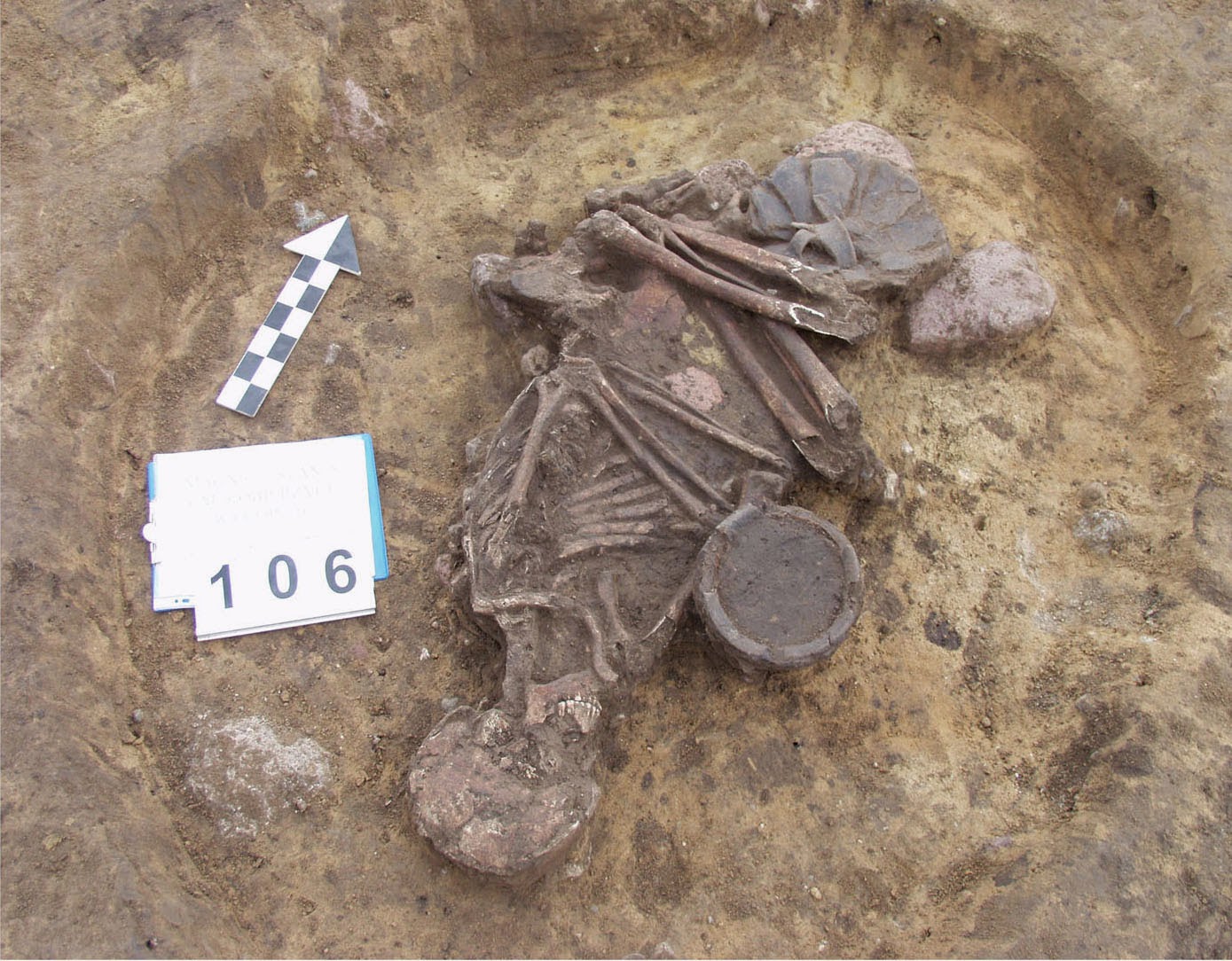
See also.
You can see several examples of this in both Bell Beaker and Nordic Bronze Age depictions in the second half of Mary Cahill's paper "Here Comes the Sun"
In this video Crecganford argues for the role of "The Ferryman" in PIE religion. Although his argument is not about Bell Beakers, it's a good background for discussing Beaker religious beliefs and the interpretation of their archaeology.
Previously, I have argued that a solarboat was part of the Beaker death sequence. I'll point to several lines of evidence from Beaker archaeology for a belief in a "ferryman of souls". In fact, depending on how far you want to invest in this idea, some items of the Beaker grave package could have new and different interpretations for gendered burials of both Beaker and CWC peoples.
Using the comparative method, Crecganford argues the Ferryman as "a certain" old man that transports the dead from the realm of the living to the realm of the dead, probably across an underworld river.
Ok, having watched that...
There's a pretty decent chance that the golden lunulae, generally dated to the Beaker Period (as the one below), are highly stylized representations of solar boats. Well, you be the judge. Since so many of them are plow finds and being metal objects, it is their motif and uniformity that place them satisfyingly in the Beaker period. These ornaments are never found on a dead body as ornamentation as you might expect for the worldly Beakers. Curiously, they seem to have been hidden away, folded and reused; in some way like an object used for special occasions.
An interesting phenomenon is when we see solar crosses directly associated with these "solar boats". If we were to suspect that Beakers spoke a language and practiced a religion of the Western Steppe, then these solar crosses help us intentify more clearly the old, bearded man who propels the solar boat (and Crecganford theorizes about this individual's lost identity in the video).
Remember we are talking of a reconstructed god deeper in time before the Beakers, but you may recognize a much later manifestation and recognize his crosses.


What about Bell Beaker grave offerings?
There has been an unchallenged assumption that Beaker offerings are for the occupants themselves. They are part of an idealistic identity and therefore we assume these grave goods reflect ideals and personal needs.
These offerings are different from personal vestment, weapons and tools. They are the accompanying gear, such as drink, meat and odd items. And while most Beaker burials lack the diagnostic riches, most probably had some sort of offering, if only perishables.
But if Beakers did indeed believe in a ferryman, would these items be more convincingly interpreted as bribes or ferry payments? Are the emblazoned, encrusted beakers containing barely and wheet beer, mead, wine, fermented milk and sometimes henbane gruits destined for the old, bearded poleman? Would simple objects, like a chip of flint or a single bead be the primative equivalent to coinage? Little bribes and tips for passage? It's funny, because without knowing it, many of us have bribed him too.
Certainly Beakers were buried facing the rising sun. We might interpret this as hope for a coming day or orientation towards a place we need to go. It would seem aspirational, and so we should remember that the crossing of any river would require a west to east movement (towards the Sun). This could be signifcant when we look at the Nebra Sky Disk in a moment. This might change how we see CWC religion as well. What if instead of viewing some sort of southern constellation, the Corded Ware people simply needed to cross a river from north to south? Perhaps this was a vestige of an older homeland above the bend of a sacred river? And speaking of the Corded Ware especially, it'd be interesting to look at the directionality of her daughter cultures and the procession of the Southern Cross, and especially Acruz.

Finally an enduring question, what is the significance of the funerary beakers? Obviously, their decoration followed a certain scheme and, in at least in the above grave, went so far to paint a ceramic red when the local clay didn't fit the color style. The inlay paste can be made of several materials, apparently it just needs to be white.
My personal opinion at the moment can be seen below. To be clear, I doubt your average Beaker farmer, who spent his entire life growing up above diverse geologies different from below, had any idea why beakers were styled a certain way. If you were to interview the women who created these beakers, I'm sure they didn't know either. They just learned all this from their elder women and so on.
But at one time, above a certain geology, either in SW Europe or the Steppe, a metaphor might have been obvious to people for a little while, if one ever existed at all. Maybe they just thought it looked good, who the hell knows.

If the Ferryman is indeed part of an IE motif, then it is possibly one line of evidence, along with genetics, that point to Beakers being one of the first cultures in Europe with strong IE affinities. We should bear in mind however, that other religions of this time had a solar ferryman, notably in Egypt. So while a ferryman belief could be exclusively IE-derived, it could equally owe some or all of its character to North African beliefs, especially given the influence North African pottery had on funerary beakers.
An even more complex scenario might exist, and Crecganford eludes to this, where the solar boat or ferry motif among PIE's drew from a larger mileu of Near Eastern, and maybe directly Egyptian influence late in its history.
Let's move now to the apparently controversial Nebra Sky Disk. I will do a separate post on the Sky Disk controversy this weekend, because I think the interpreation of many archaeologists is still correct and I'd like to add a few supporting arguments for the traditional interpretation.
It has been assigned to the much more sophisticated Unetice Culture in Saxony-Anhalt which supercedes the old Beaker culture. You may see naked ladies in it, and there's all sorts of retarded interpretations, but I see a solar boat transitioning from firmament to firmament, from the realm of the moon to the realm of the sun. Mythologically, the realm of the dead.

While I'm still considering the interpretation of some of the proposed constellations, I do feel very comfortable with the assignment of Lupus and Pleiades. I think these assignments were very clever and very correct. They also tell us something very important about the mythological associations with the solar boat and the disk.
Lupus hints at the identity or association with the solar boat and the judgement that awaits our transition to death. Lupus stands ready to devour the condemed and his position in the disk is notable.
Below it is Pleiades, often subject to lunar and inner-planetary occulations (Mercury, Venus and Mars) because of its distance to the ecliptic. Additionally, it was at heliacal rising in ancient times peaking around Halloween. So it is easy to understand how in the comparative mythologies of the Greeks, Celts and Germans that the maidens are often associated with the Sun god and death.
Pleiades is important in when looking at what they mean for a dead person. Taken from across the Western religions; they are present at judgement. In the book of Revelations, they are held in the right hand of the Messiah.
They prepare and guide us on sea journeys. They were transformed from maidens into birds (Freya's hen, or Atlas's doves). They sift among the dead. There are various myths in which one of the maiden's abandons the others (and I'm curious if this was a template for the devleopment of a separate motif in Germanic myth for the Valkyries).

Replica of a beaker from the Wilsford Beaker Group by Graham Taylor
You can buy one of these at potted-history.co.uk
...and quite honestly, given the meaningless fucking crap that fills the box stores these days, to give one of these beautiful vessels as a birthday or Christmas present would mean a lot to just about anyone.
Crecganford is my evening go-to for reconstructed PIE mythology.
 |
| Secondary motif originating in green |
A few thoughts on Bell Beaker "iconoclastic" tendencies.
Crecganford notes Indo-European gods were originally spirit gods. Theologically, they lacked incarnation, but also the iconography and idolatry that was prominent throughout the Mediterranean and temperate Europe at that time.
Bell Beaker impulses appear, as Antonio Valera described, almost "iconoclastic" in their approach or art. Their decorations are highly geometric and repetitive. If icons of religion are depicted, they seem to be highly stylized skeumorphs, whether solar boats or suns. And at our very best, we can only say the things they drew well were daggers and little else, and these appear to by symbolic.
Every culture before them had art, any art. What does this mean?
If Bell Beakers had a largely IE religion, then it would make sense that their gods were worshipped in song and story, not in ways that involved incarnations. Physical representations might have even been taboo.
Not really what they were looking for, but they found a lot of activity associated with flint mining in chalk. The strangest feature was a kind of sacred tree enclosure with flint nodule offerings.
Phillip Stockhammer looks at the patterns of social position among women within the Lech Valley farmsteads.
He makes a fairly compelling case that some of these imported women were wet nurses. All women are non-local, but the mistresses are less non-local than women in servitude. Or however one wishes to phrase it.
Here's the only Iberian halberd deposited in context as part of the warrior package. It's context is discussed in "Atlantic Halberds as Bell Beaker Weapons in Iberia: Tomb 1 of Humanejos (Parla, Madrid, Spain)"
Although quite a few halberds are found in scattered and wrecked contexts, it's rare to find in a grave. It may well be that elite tombs were more susceptible to plunder and vandalism and so halberds might be under-represented for that era. The authors point out that halberds were Europe's first metal-conceieved weapon.
The weapon below appears to have been repaired many times after impact. The first indication is that it was re-hafted several times due to blunt force. The most recent hafting involved substituting a nail for a rivet. Clearly it was not a letter-opener.
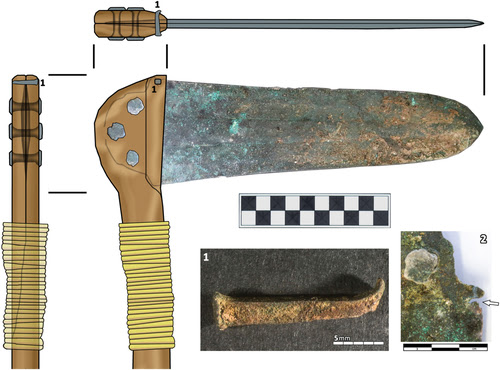 |
| Close-up of replacement nail and use-wear |
Tomb 1 is located near Madrid and features a man and woman. The tomb had an entrance and was not filled in, so the woman's body had already decomposed before her husband (?) was laid to rest. Her body was "scooted over" and the authors suggest the ivory buttons from her vestment might have been collected in hand to her pot.
While it is clear she was buried first, the man radiocarbon dates older even though it is clear that they both decomposed in the tomb itself. I may revisit this issue in a subsequent post. In any case, she is buried with women's gear and he is buried with warrior gear.

There's several things that come to mind with halberds. One is that they may be indicative of social rank, perhaps as part of a social division of arms (Meller, 2017). At the same time, these weapons were used a lot and the use-wear suggests more than (Horn, 2017) some domestic chore like punching holes in domestic cattle skulls.
Reverse-engineering needs requirements takes us to an interesting place in Beaker warfare. We have long-range weapons (at least two types of bows), a personal space and dualing fighting weapon (daggers), beyond arms length offensive/defensive weapon (the spear or javelin). And then we have this weird, centrifugally accelerated, blunt force weapon. Why?
I think it's probably an indication of primative armor and sheilds. Of course armor of that time would have been boiled leather and probably quite effective. The real question is that if a halberd is nothing more than a dagger on a stick, then why position it at 90 degree angle? Without the need for penetrative force, there is no advantage for killing someone extra.
Use-wear and common sense point to a rotation plane, something like an axe or hammer. That means a halberd point is approaching a victim with multiples of speed and force than would be required if we are simply dealing with defenseless, naked humans. It's like shooting someone with a bazooka. Is shooting someone with a bazooka as effective as a rifle? Yes, same result I guess. But we would correctly suppose that a high-cost, single-shot, shoulder-fired weapon like a bazooka was developed to bust armor.
As was the case throughout the Medieval Period, it may have been the elite or professional warriors who wore armor while commoners were outfitted modestly. So there are several scenarios in which Beaker halerds may have been used. Armored warrior elites against armored elites. Anyone versus armored warrior elites.
If all the above is true, we have a new problem. Being equipped with a Palmela point makes sense if we are dealing with a warrior on foot who can punch a spear beyond arms length. But this warrior is equipped with both a halberd and two points. I doubt the mourners just threw a bunch of man stuff into a grave. Could it be that the Palmela point (having no barbs mind you) was specifically used in equistrian combat? Similar weapons were used in the Medieval period simply for punching sorry souls on the ground by mounted warriors.

And finally, another clear example of a "bracer" that fell off the outside of a decomposing arm. I think at this point we can safely say that these are not actually bracers but an exterior (or sometimes interior) backbone of a larger bracing cuff. Maybe this was to protect the wrist from injury to to relieve stress on the lower arm. Who knows.
The Smithsonian "Evidence of Neolithic Construction Boom Found at British Mega-Henge"...
Mount Pleasant may have been built in 35 years, like so many of these expensive projects, right on the cusp of the Beaker invasion of Britain. (Soft Language option available here.)
In "Tempo of a Mega-henge", Greaney et al. consider the flurry of mega-project activity in relation to the subsequent appearance of early Beaker pottery and monument vandalism. Suggesting somewhat indirectly, a prelude of apprehension on the landscape. Or, using my words, possession insecurity, invasion anxiety or perhaps even a "siege-mentality". This is not an insignificant question as the entire archipelago was followed by several centuries of immigrant implantation and foreign cultural ascendancy.
The "positive structures", as Antonio Valera terms, might then be evidence of a deeper psychological need to strengthen entitlement to ancestral lands, marking the landscape as the established domain of a people, living and dead. Legitimate title being conveyed from the ancestral to the living, reinforced by increasingly permanent memorials and spiritual monuments.
 |
| Owning the landscape, American-style |
Once thought to be an evolution of hundreds of years, Mount Pleasant was one of many British and Irish sites built very quickly:
The estimate for the construction of the Mount Pleasant palisaded enclosure, 2530–2465 cal BC...places it firmly within the currency of large timber palisades constructed across Britain and Ireland in the late Neolithic...tightly cluster in the centuries around 2500 cal BC. These date estimates do not support previous suggestions that enclosures with continuous ditches developed out of earlier enclosures with well-spaced individual posts
and using an illustration from Stonehenge, by coincidence:
The evidence from Site IV [the probable vandalization of Stonehenge by early Beakers] raises interesting questions about the relationship between those people involved in frenetic and labour-intensive monument construction [Groove Ware folk] and the arrival of Beaker-using people.
We cannot know what native Neolithic peoples thought of Beakers or why they increased building activities toward the end of the Neolithic. Were projects simply one manifestation of a local prosperity that attracted immigrants? Or do the monuments represent a psychological reaction to disruptions in the continent?
One way to analyze the behavior of Neolithic building projects is to approach it from the aspect of evolutionary psychology. I've discussed such pre-programmed behaviors here an here. How humans create defensible space and territoriality is part of the basis of environmental psychology.
We impose our claim to spaces with artifacts of our belonging. Whether it's piling stuff on your desk at work or leaving a jacket on a diner's table while you head to the restroom; we derive these behaviors from our animal programming, not from cognitive thinking.
 |
| Fake Chinese island. Or modern Crannog? |
We leave our jacket on the table by building intrusive, fake islands in the waters of other nations to claim oil and gas. Planting a flag on the moon, repurposing religious spaces into that of a foreign religion, destroying and cultivating outright. There's no shortage of examples, from Jerusalem to Azerbaijan, New World, Old World. Claims, identity and security are projected on to the landscape.

 |
| Durrington Walls site (Midnight owl, commons) |
Greaney, S., Hazell, Z., Barclay, A., Ramsey, C. B., Dunbar, E., Hajdas, I., … Marshall, P. (2020). Tempo of a Mega-henge: A New Chronology for Mount Pleasant, Dorchester, Dorset. Proceedings of the Prehistoric Society, 1–38. doi:10.1017/ppr.2020.6
Radiocarbon dating and Bayesian chronological modelling have provided precise new dating for the henge mon- ument of Mount Pleasant in Dorset, excavated in 1970–1. A total of 59 radiocarbon dates are now available for the site and modelling of these has provided a revised sequence for the henge enclosure and its various constituent parts: the timber palisaded enclosure, the Conquer Barrow, and the ditch surrounding Site IV, a concentric timber and stone monument. This suggests that the henge was probably built in the 26th century cal BC, shortly followed by the timber palisade and Site IV ditch. These major construction events took place in the late Neolithic over a relatively short timespan, probably lasting 35–125 years. The principal results are discussed for each element of the site, including comparison with similar monument types elsewhere in Britain and Ireland, and wider implications for late Neolithic connections and later activity at the site associated with Beaker pottery are explored.
Psychologist Robin Dunbar believes there are numerical ranges of "friend categories" that most efficiently support us, but also biological lower and upper limits to these categories. In others words, we are all wired with the same social limits.
See "Revealed: The EXACT number of friends you need to be successful" DailyMail.

What caught my interest is that Robin Dunbar believes these divisions may also be the basis for infantry unit structures, from squads to platoons, etc. The nomenclatures and weapons vary across the ages, but at least in West Eurasia, seem to follow similar social blueprints, roughly falling in numerical categories with high and low limits.
Of course, each unit can be reinforced or have detachments, and units were sometimes perfected by sexagesimal or decimal factors. It's also worth pointing out that specialized units (artillery, calvary, oarsmen, dragoons, archers, aviation, engineering companies) may be numerically structured for specific tasks.
This got me thinking about Harald Meller's paper looking at ceremonial weapons deposits at an "Unetice barracks" at Dermsdorf in Sömmerda District, Germany. There, we see what may be strangely reminiscent of modern units, complete with a social division of arms. Meller's ideas are by far, the most logical and intelligent interpretation of weapons depositions from the Bronze Age. They are military deposits, possibly of a ceremonial or religious natures. Practical is not impossible either. (everything other theory is rolled eye whites, foaming at the mouth, holding snakes and murmuring devil words)
If Dunbar is correct, then maybe we shouldn't be so surprised by Dermsdorf after all. For that matter, what precludes sufficiently-numbered Neolithic people from organizing war units this way?
 |
| Barrow at Normanton Down, Wilshire (Historic England) |
...but while male mobility is viewed as the result of activities such as warfare and trade, women are figured as passive objects of exchange in exogamous patterns of marriage (Frieman et al. 2019). Women, it is argued, moved as wives, while men moved as significant social agents. The language of nineteenth-century evolutionism is reflected in the image of young male war-bands whose aggressive, competitive actions reflect an innate drive to attain political and economic domination. We can call into question the double standards that pervade this difference in the interpretation of male and female mobility.
"Large-scale archaeogenetic studies of people from prehistoric Europe tend to be broad in scope and difficult to resolve with local archaeologies. However, accompanying supplementary information often contains useful finer-scale information that is comprehensible without specific genetics expertise. Here, we show how undiscussed details provided in supplementary information of aDNA papers can provide crucial insight into patterns of ancestry change and genetic relatedness in the past by examining details relating to a >90 per cent shift in the genetic ancestry of populations who inhabited Chalcolithic and Early Bronze Age Britain (c. 2450–1600 BC). While this outcome was certainly influenced by movements of communities carrying novel ancestries into Britain from continental Europe, it was unlikely to have been a simple, rapid process, potentially taking up to 16 generations, during which time there is evidence for the synchronous persistence of groups largely descended from the Neolithic populations. Insofar as genetic relationships can be assumed to have had social meaning, identification of genetic relatives in cemeteries suggests paternal relationships were important, but there is substantial variability in how genetic ties were referenced and little evidence for strict patrilocality or female exogamy."
Continuing the discussion on very long distance Beaker mobility...
After the previous post "Iberians in Suprasl?", someone sent me this recent paper, "Paleoclimate and Cultural Genesis in Eastern Europe at the End of the 3rd Millennium B.C." 2018 by Roman Mimokhod.
The question is, if Beaker influences in the SW Baltic now have the option of transmission from actual immigrants rather than chain transmission through intermediary cultures, should we more carefully consider that other peripheries expressing Beaker characteristics may have also recieved direct immigration?
To put another way, given that we have ample proof that Beakers travelled very long distances in a single lifetime (perhaps even within a few weeks), and given their lack of respect for any sort of boundary (geographic, tribal, climatic, linguistic, moral), and given their propensity to dot regions with outposts in the backyards of native cultures, is it not simpler to assume peripheries with Beaker influences had local Beaker settlers, or at least traders, prospectors, marriage partners?
How about the Middle Volga? How about early Abashevo?

This is not to suggest any part of the Abashevo Complex should have any significant Beaker ancestry. If it did, it would surely be a fraction. Rather, the point here is identifying those attributes that remind us of the Beaker Culture and trying to understand how these elements surfaced in such a far away place.
Beaker settlements in the Ukraine/Southern Russia should not seem too absurd; as I have suggested before, their migration does not appear to have been a mindless process, like a liquid spreading equally in the absence of resistance, seeping into every crevice along the way. Their earliest presence in any area appears to target raw materials or favorable positions.
There is no doubt that migrations from Central Europe laid the foundational layers for the rise of Abashevo. Did cultural Beakers migrate?
ПАЛЕОКЛИМАТ И КУЛЬТУРОГЕНЕЗ В ВОСТОЧНОЙ ЕВРОПЕ В КОНЦЕ III тыс. до н.э. DOI: 10.7868/S0869606318020046
Р. А. Мимоход, 2018
РОССИЙСКАЯ АРХЕОЛОГИЯ, 2018, No 2, с. 3348
Translated..
At the end of the 3rd millennium, a block of post-catacomb cultural formations was formed in Eastern Europe on the genetic basis of catacomb cultures. It consists of the Babino cultural circle and the Lola cultural circle. The first of them was formed due to the migration impulse from Central Europe and the Carpathian-Danube region, the emergence of the second was stimulated by the migration of pastoralists of the North-Eastern Caucasus to the Ciscaucasian steppe. In turn, the movement of population groups from Europe led to the emergence of a bright, distinctive Middle Volgian Abashev culture of a Central European appearance. Large-scale migrations in Eastern Europe XXIII / XXII centuries. BC. coincided with the peak of aridization in the Old World. These two phenomena are in a causal relationship.
